
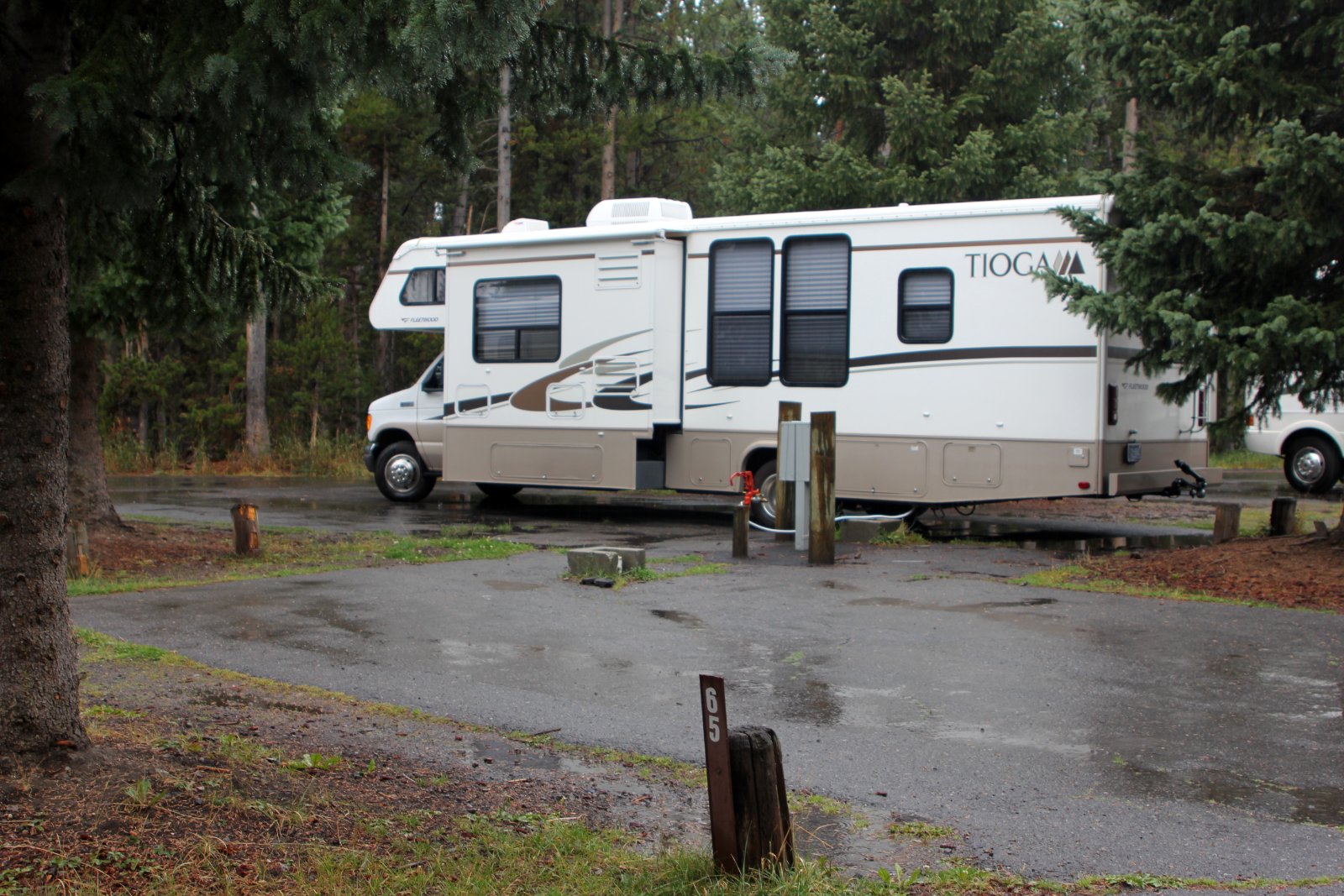
Yellowstone National Park has 12 campgrounds. Yet only one—Fishing Bridge RV Park—has electric hookups. At the other 11, campers must spend the night relying on a generator, batteries, or solar power, with neither electrical nor water connections. Anyone parking an RV on this geothermal landscape needs to understand that difference first.
Only One of the 12 Has Electricity
Yellowstone’s campgrounds vary widely in size and character. Bridge Bay Campground has 432 sites and costs $33 per night. Canyon Campground has 273 sites at $39, Grant Village has 430 sites at $39, and Madison Campground has 276 sites at $33. Mammoth Campground has 85 sites for $25 but no dump station. Indian Creek and Lewis Lake campgrounds, with 70 and 85 sites respectively, cost $20 and are among the park’s least expensive options, but neither has sewage disposal facilities. Norris Campground has 112 sites.
Fishing Bridge RV Park is the only one with electricity. All 310 sites have electric hookups, along with a dump station, coin-operated laundry, and coin-operated showers. It is also the park’s most expensive campground, at $89 per night. Tents and tent trailers are not permitted. Only hard-sided RVs are allowed because the area is frequented by grizzly and black bears, and tent camping is prohibited altogether. Most of the other campgrounds accommodate tents and RVs in the same areas.
Reservations Are Handled Through Two Systems
Yellowstone National Park Lodges takes reservations for some campgrounds, including Fishing Bridge RV Park. Its phone number is 307-344-7311, with a separate TDD service for guests with hearing disabilities at 307-344-5395. Most other campgrounds use the Recreation.gov reservation system. During the peak summer season, popular sites can disappear as soon as reservations open, so planning several months ahead is the safer approach. Fishing Bridge RV Park is seasonal and closes from mid-October through early May of the following year. During that period, snow covers the park and significant portions of Grand Loop Road are closed to vehicle traffic.
Rates range widely, from $20 per night to $89. Campers willing to forgo electricity and hot showers may prefer a quiet, lower-cost campground such as Indian Creek or Lewis Lake. Those staying for several days who want to handle laundry and charging in one place may find Fishing Bridge RV Park more convenient.
What Happened at Yellowstone This Summer
On July 23, 2024, a hydrothermal explosion occurred at Biscuit Basin north of Old Faithful. As a result, the parking lot, boardwalk, and nearby Firehole River area remain fully closed because of the possibility of additional explosions. Fishing was fully prohibited on the Madison, Firehole, and Gibbon rivers as water temperatures rose and flows declined. At Gibbon River Bridge, guardrail repairs were causing delays of up to 15 minutes throughout July. The Gardner River High Bridge area was also under 24-hour one-way traffic control, with delays of up to 15 minutes. Travelers using Grand Loop Road needed to allow extra time for these sections.
Parking an RV in Grizzly Country
Yellowstone is one of the few places where grizzly bears and black bears share the landscape. In campgrounds, food, trash, and cooking equipment should be stored in bear-resistant storage or inside a vehicle. That is also why Fishing Bridge RV Park does not allow tents. Sleeping inside a hard-sided RV and sleeping behind a thin layer of fabric can lead to very different outcomes in a bear encounter. Leaving a grill or cooler outside overnight is not acceptable in Yellowstone.
How to Tour Yellowstone by RV
The park is organized around the figure-eight-shaped Grand Loop Road. Travelers entering from the east are closer to Fishing Bridge and Bridge Bay, while Madison Campground is a suitable first stop from the west entrance. Popular destinations such as Old Faithful and Grand Prismatic should be reached before 8 a.m. to avoid parking problems. RVs can generally travel the full Grand Loop Road, but routes should account in advance for the Biscuit Basin closure and the delay zones at Gibbon River Bridge and Gardner River High Bridge. Drivers of larger RVs should also keep daily travel distances short to allow for sharp curves in canyon sections and wildlife-related traffic backups.
What to Consider When Choosing a Campground Without a Dump Station
If choosing a campground without a dump station, such as Indian Creek, Lewis Lake, or Mammoth, it is wise to calculate available black-tank and gray-tank capacity in advance. Travelers planning to stay in Yellowstone for several days can use Fishing Bridge RV Park, or Bridge Bay, Canyon, Grant Village, or Madison campgrounds with dump stations, as intermediate stops to empty tanks before returning to a quieter campground. Moving every few days between lower-cost sites and those with more facilities is one way to tour Yellowstone.
Extra Considerations for Larger RVs
Most park roads are well paved, but canyon and mountain-pass sections include sharp curves and narrow shoulders. Drivers of Class A motorhomes longer than 30 feet or travel trailers should expect frequent slowdowns and stops in areas that draw wildlife-viewing vehicles, including Hayden Valley and Dunraven Pass on Grand Loop Road. Campsite sizes also vary, so it is best to enter the RV’s exact overall length when making a reservation. During the season, campgrounds fill up and it can be difficult to change sites after arrival.
What You See When You Avoid Midsummer
July and August are Yellowstone’s most competitive months for reservations. Crowds gather everywhere, from campground sites to the Old Faithful parking lot and the Grand Prismatic overlook. Even within the same summer, shifting a trip to early June or September can noticeably reduce road congestion and campground waits. However, high-elevation roads may still hold snow or receive early snowfall, so tire condition and tire-chain readiness should also be checked. For seasonal campgrounds such as Fishing Bridge RV Park, it is advisable to confirm opening and closing dates each year.
A Checklist to Review Before Check-In
Before departure, review the reservation confirmation to make sure the campground name, check-in time, and listed RV length match the actual vehicle. Even at a campground with electric hookups, such as Fishing Bridge RV Park, cord and adapter requirements can vary, so bringing both 30-amp and 50-amp adapters is the safer choice. When heading to a campground without a dump station, empty waste tanks as fully as possible before leaving and fill the fresh-water tank instead. Fuel up in advance as well, since gas stations are widely spaced inside the park. Cell service is unavailable in most areas, so save campground locations and the route to the next destination on an offline map before setting out.
Data Source: NPS API (developer.nps.gov) / Recreation.gov RIDB
Photo: NPS/Renkin, Fishing Bridge RV Park — https://www.nps.gov/yell/planyourvisit/campgrounds.htm