
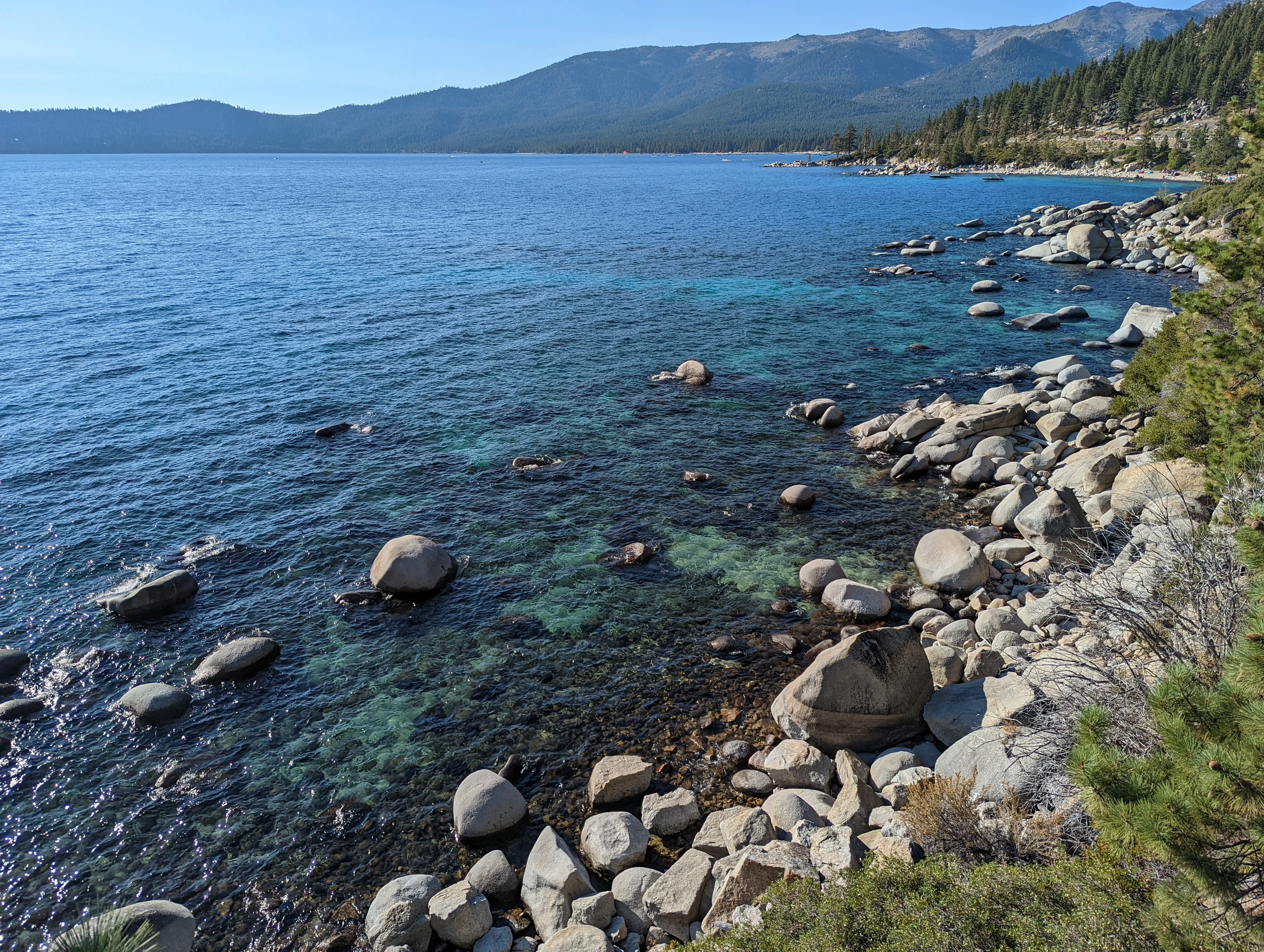
Straddling the Nevada-California border, Lake Tahoe takes on a much quieter character along its east shore than in the busy urban area of South Lake Tahoe to the west. Following the lakeshore, U.S. Highway 50 and Nevada State Route 28 make this a camping route best enjoyed at an unhurried pace rather than as a quick pass-through.
Nevada Beach Campground, the Closest Stay to the Shore
According to official facility information from Recreation.gov, Nevada Beach Campground is on U.S. Highway 50, 2 miles east of the California-Nevada border. It is only a few minutes’ walk from Lake Tahoe’s bright turquoise water, with campsites tucked among open pine forest. A sandy beach and a range of water-recreation options are nearby, as is the Stateline district, where restaurants and casinos are clustered.
Most sites are standard nonelectric sites without electric, water, or sewer hookups. Maximum vehicle lengths vary widely by site, from 38 to 58 feet, making it possible to find space for anything from a midsize travel trailer to a large Class A motorhome. With no hookups available, it is wise to fill the fresh-water tank and check gray- and black-water capacity before leaving. Reservations fill quickly in popular seasons, so once travel dates are set, travelers should check each site’s maximum vehicle length and driveway conditions on the reservation page.
Zephyr Cove and Cave Rock, Pauses Along the Road
A short drive south from Nevada Beach on U.S. Highway 50 brings travelers to the Zephyr Cove area. With a sightseeing-boat dock, beach, and restaurants in one place, it is a good stop to park the RV briefly and explore on foot. Farther south, the road passes through Cave Rock, where it is carved along cliffs immediately beside the lake. The sudden opening of lake views while passing through the tunnel is one of the route’s signature moments.
For travelers seeking electric, water, and sewer hookups, Zephyr Cove RV & Campground, operated by Zephyr Cove Resort, is an alternative. Facility information listed on Recreation.gov highlights its location on Lake Tahoe’s southeast shore, within walking distance of Zephyr Cove Beach. Directions from Reno Airport call for taking U.S. 395 and I-580 through Carson City before joining U.S. Highway 50; from the Sacramento area, the listed route follows U.S. Highway 50 to Pioneer Trail in El Dorado County. Travelers who want full-hookup sites may prefer reserving here rather than a nonelectric site at Nevada Beach.
Heading north along the east shore leads to Nevada State Route 28, which passes near Sand Harbor State Park. Known for its clear water and granite-lined shoreline, the area’s parking lots often fill early during peak season, so travelers in large RVs are better off arriving in the morning.
What to Keep in Mind When Driving an RV
Much of the east-shore road has two lanes in each direction, but there are also narrow tunnel sections cut through rock, including at Cave Rock. Drivers of large RVs or a fifth wheel should leave ample room from oncoming traffic and avoid forcing a stop at viewpoints with narrow shoulders. At nearly 6,200 feet above sea level, the lake sits at high elevation, and morning and evening temperatures can drop sharply even in late summer, making heating preparation helpful.
Traffic is often heavy in South Lake Tahoe and the Stateline area on weekends and during the summer peak season. Travelers in large vehicles may find that departing early in the morning or later in the afternoon reduces stress. After setting up at the campground, using a tow vehicle or smaller car for trips to Zephyr Cove, Cave Rock, and Sand Harbor is much easier than taking a large RV into narrow viewpoint parking areas.
Towns where travelers can refill fuel and drinking water are largely limited to South Lake Tahoe and Incline Village, so anyone planning to spend extended time on the east shore should fill their tanks before setting out. Wildlife, especially deer, can enter the roadway at night, so slowing down after sunset is the safer choice.
When to Go
Lake Tahoe is a high-elevation alpine lake, so mornings and evenings remain cool even in summer, while midsummer daytime temperatures tend to stay mild rather than becoming intensely hot. After Labor Day weekend, peak-season crowds noticeably decline and campground reservations become easier, but nighttime temperatures also begin to fall sharply. Travelers planning an autumn visit should bring ample heating equipment and warm bedding. Snow and ice are common on winter roads, making large-RV travel difficult, so late spring through early fall is generally the most manageable period for an RV trip.
The east shore’s main appeal is its remaining natural lakeside scenery and fewer commercial facilities compared with South Lake Tahoe on the west. Rather than passing through in a day or two, travelers can park their RV at Nevada Beach or Zephyr Cove for at least two nights and take their time enjoying the beach, hiking, kayaking, and other water activities to fully appreciate the route.
Data Source: Recreation.gov RIDB
Photo: Blake Everett Carroll / Original photo. CC BY-SA 4.0. Photo date: 2022-09-04 17:14:38. Resized and compressed for display.
