
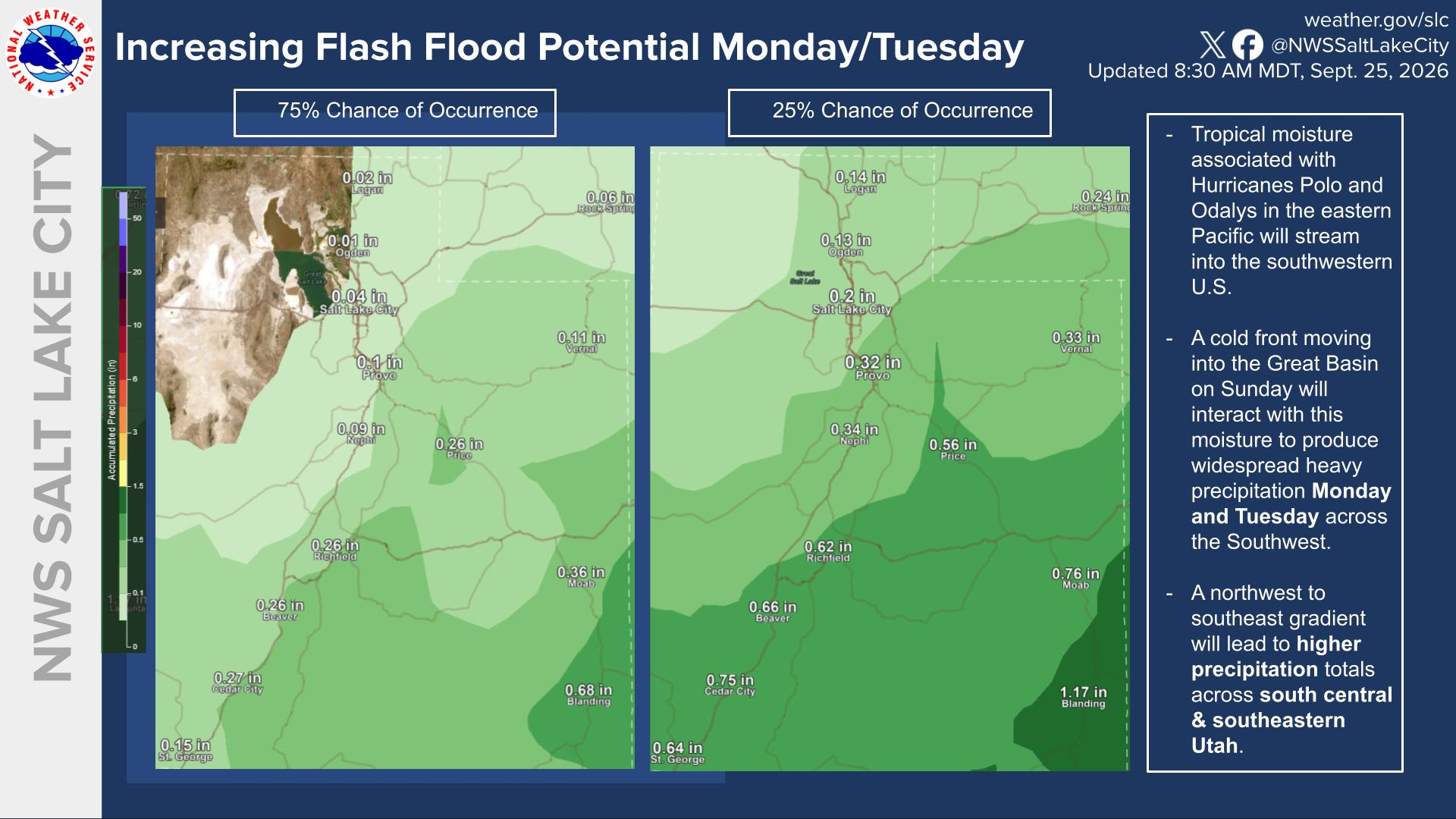
If you plan to finish a weekend of camping at Zion and continue canyon hiking through Monday and Tuesday, leave room to adjust your itinerary. In an outlook map released at 8:30 a.m. MDT on Sept. 25, the NWS Salt Lake City office said the potential for flash flooding could increase on Sept. 28–29. Moisture associated with Tropical Systems Polo and Odalys was expected to move into the Southwest as a front approached, potentially expanding rainfall. This was not an announcement that flooding was occurring at Zion at the time or that closures had been decided for those dates.
Areas Affected
The outlook covered a broad region that includes southern Utah, with the greatest rainfall expected over south-central and southeastern areas. Southwestern Utah, where Zion is located, should not be treated as the same as the map’s highest-precipitation forecast area. Travelers staying at Zion via St. George and Springdale, as well as those continuing east afterward, should check the forecast for each destination separately.
The forecast discussion updated early on the 25th described relatively dry, stable weather for Saturday the 26th, followed by increasing moisture beginning on the 27th and the potential for more widespread precipitation on the 28th and 29th. Rainfall totals could vary with the movement of the low-pressure system and the moisture supply. The precipitation scenarios shown alongside each other on the map reflect that uncertainty; they should not be read as a confirmed rainfall total or flood probability for a particular campground.
In Zion’s narrow canyons and dry washes, heavy rain upstream can create danger even when rain is not visible at your location. The NPS notes that storms several miles away can trigger flash flooding. A plan to remain at a campground and a plan to enter The Narrows along the Virgin River cannot be treated as the same decision. Before entering a watercourse, check that day’s canyon-specific flood outlook.
What RV Travelers Need to Know
According to NPS operating information, Watchman Campground is open year-round, and reservations are required for park campgrounds. Having a lodging reservation does not guarantee that canyon travel will be possible. The park says it closes The Narrows when Virgin River flow exceeds 150 cubic feet per second or when the NWS issues a flash-flood warning. Recheck park notices and flow information before departure and again after arriving.
Check the latest flash-flood potential rating at the visitor center. If a risk is posted, choose alternative activities that avoid narrow canyons, dry washes, and small streams. The NPS identifies suddenly muddy water, increasing floating debris, rising water levels, and louder water sounds as warning signs. If you encounter a flood, move to higher ground without delaying to gather gear, and do not attempt to cross the water.
The key for this trip is not to lock in Sept. 28–29 plans based on the weekend’s relatively stable weather. Review separately the date you will move your RV, the deadline for changing campground reservations, and the date you plan to enter a canyon. Check NPS operating notices for park road conditions and Utah transportation agency advisories for routes outside the park; do not assume a specific road is already closed based only on a future rain forecast.
Sources: NWS Utah weather outlook · NWS Salt Lake City forecast discussion · Zion operating conditions · Zion flash-flood information
Photo: NOAA/NWS Salt Lake City / Original photo page (Public Domain, no copyright is claimed in the original government work · Terms of use)