
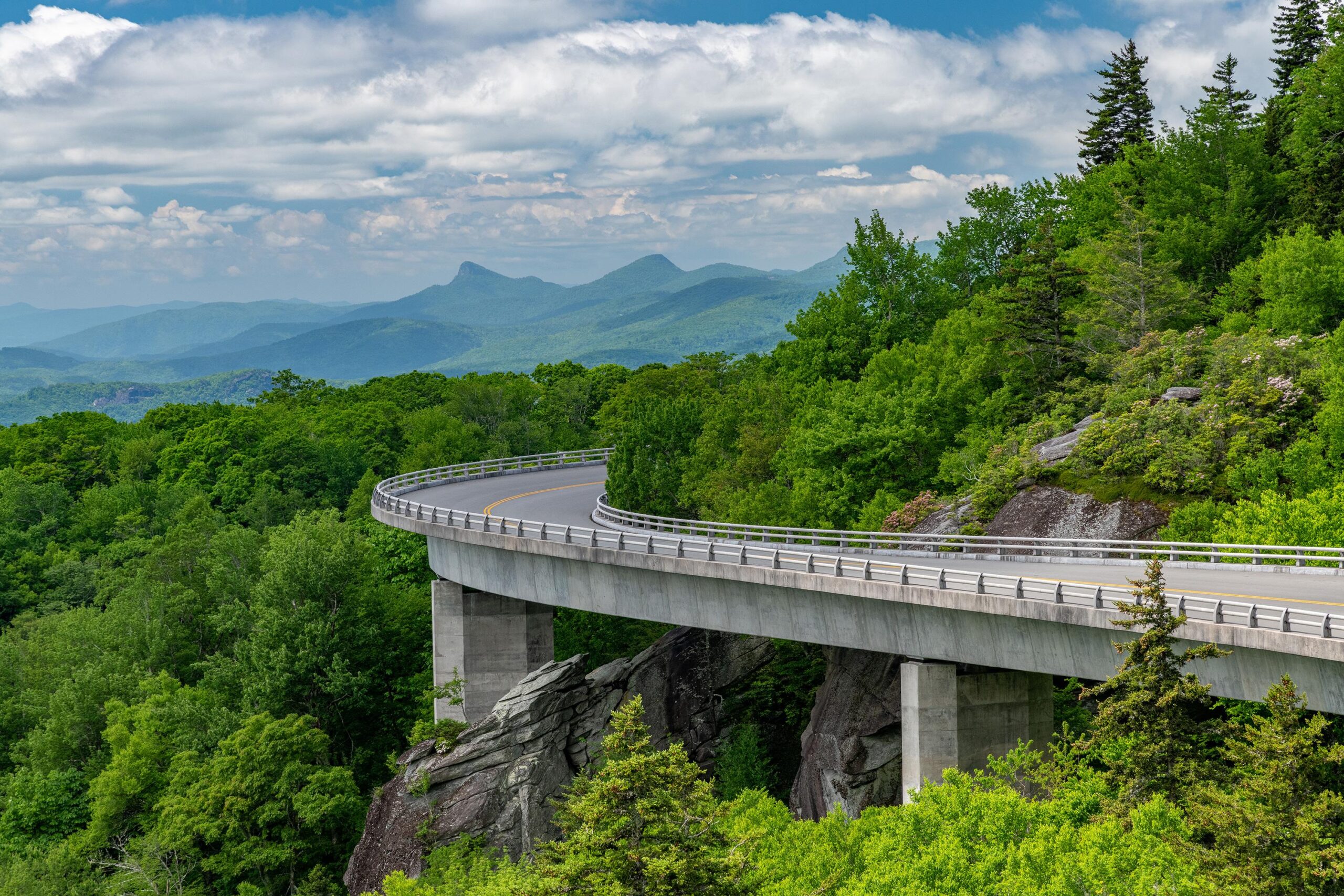
The sky opens above the viaduct, but about 100 miles south, a tunnel bored straight through a mountain awaits. Its clearance is 11 feet 7 inches—the lowest on the Blue Ridge Parkway.
26 Tunnels Along a 469-Mile Ridge Road
The Blue Ridge Parkway follows the Appalachian ridgeline for 469 miles. There are 26 tunnels along the route, and each lists two clearance figures: the maximum at the road’s centerline and the minimum at its edges. For a wide vehicle, or one that drifts away from the centerline, the actual clearance is closer to the lower edge figure. The Parkway also officially notes that pavement conditions can change those measurements by 1 to 6 inches. Rather than taking posted numbers at face value, travelers need to leave a margin.
The Lowest Opening: Big Witch
The lowest of the 26 tunnels is Big Witch Tunnel at Milepost 461.2. It has an edge clearance of 11 feet 7 inches and does not exceed 18 feet even at the centerline. At 353 feet long, it is relatively short, but for an RV carrying rooftop air conditioners, vents, or a cargo box, that one number can determine whether passage is possible. Nearby Ricks Ridge Tunnel at Milepost 458.8 offers little more room, with an edge clearance of 11 feet 8 inches. Both tunnels are clustered near the Parkway’s southern end, close to the boundary of Great Smoky Mountains National Park.
The Last Piece, Completed in 1987
More than 100 miles north, the landscape near Grandfather Mountain presents a different side of the same Parkway. Instead of cutting through the mountain like a tunnel, the Linn Cove Viaduct curves around its slope. It was completed in 1987 using 153 concrete segments, each weighing 50 tons, to form a 1,243-foot structure. The bridge was the final piece of the Parkway, whose construction began in 1935. The decision to preserve Grandfather Mountain’s ecology by building around it rather than cutting into the mountain delayed completion by nearly half a century. Because this stretch is an open viaduct rather than a tunnel, travelers can take in the ridgeline views without a clearance restriction.
More Than 3 Feet Between the Lowest and Highest
Clearances vary considerably among all 26 tunnels. Big Witch, the lowest, has an edge clearance of 11 feet 7 inches, while Rattlesnake Mountain Tunnel at Milepost 465.6 rises to 14 feet 8 inches by the same measure. That is a difference of more than 3 feet between tunnels on the same road. Tunnel lengths also range widely, from 182 feet at Rough Ridge, Milepost 349.0, to 1,462 feet at Pine Mountain, Milepost 399.1. Clearing one tunnel does not guarantee clearing the next, so travelers need to check every sign throughout the drive.
A Road Begun in 1935
Construction on the Blue Ridge Parkway began in 1935, with the goal of linking Shenandoah National Park and Great Smoky Mountains National Park along the ridgeline. More than half the route was completed relatively early, but difficult terrain near places such as Grandfather Mountain left its construction method unresolved for years. An agreement was eventually reached to build a bridge rather than cut into the mountain, and the Linn Cove Viaduct was completed in 1987, half a century after construction began. Only then was the full Parkway connected without interruption.
Start by Measuring Your Height
The Parkway’s repeated advice is simple: measure your vehicle’s actual height before setting out. That measurement must include rooftop carriers, kayak racks, and air-conditioning units. Check the official tunnel-clearance table in advance, and leave a minimum safety margin between the posted figure and your vehicle height. Road-condition updates and closure information are available through the National Park Service’s Blue Ridge Parkway page.
A Road With Few Gas Stations or Restaurants
Commercial services are scarce along the Blue Ridge Parkway. Travelers should not expect gas stations or restaurants on the road itself and should stock up on fuel, drinking water, and snacks in nearby towns before entering the Parkway. That is why the official website maintains a separate guide to locations with fuel and EV charging. For RV travelers planning to drive this road, watching the fuel gauge matters as much as checking the tunnel-clearance table.
Between the Northern Bridge and Southern Tunnels
Ultimately, how a traveler can use this road depends on vehicle height. Low-roof sedans and small vans can travel the full 469-mile route without interruption. RVs with rooftop equipment, however, are better off planning detours in advance for the low-clearance tunnel sections in the south. The open views from the Linn Cove Viaduct and the narrow entrances at Big Witch and Ricks Ridge show two very different faces of the same road.
Photo: Harold Blackwood Photo, National Park Service (nps.gov/blri)