
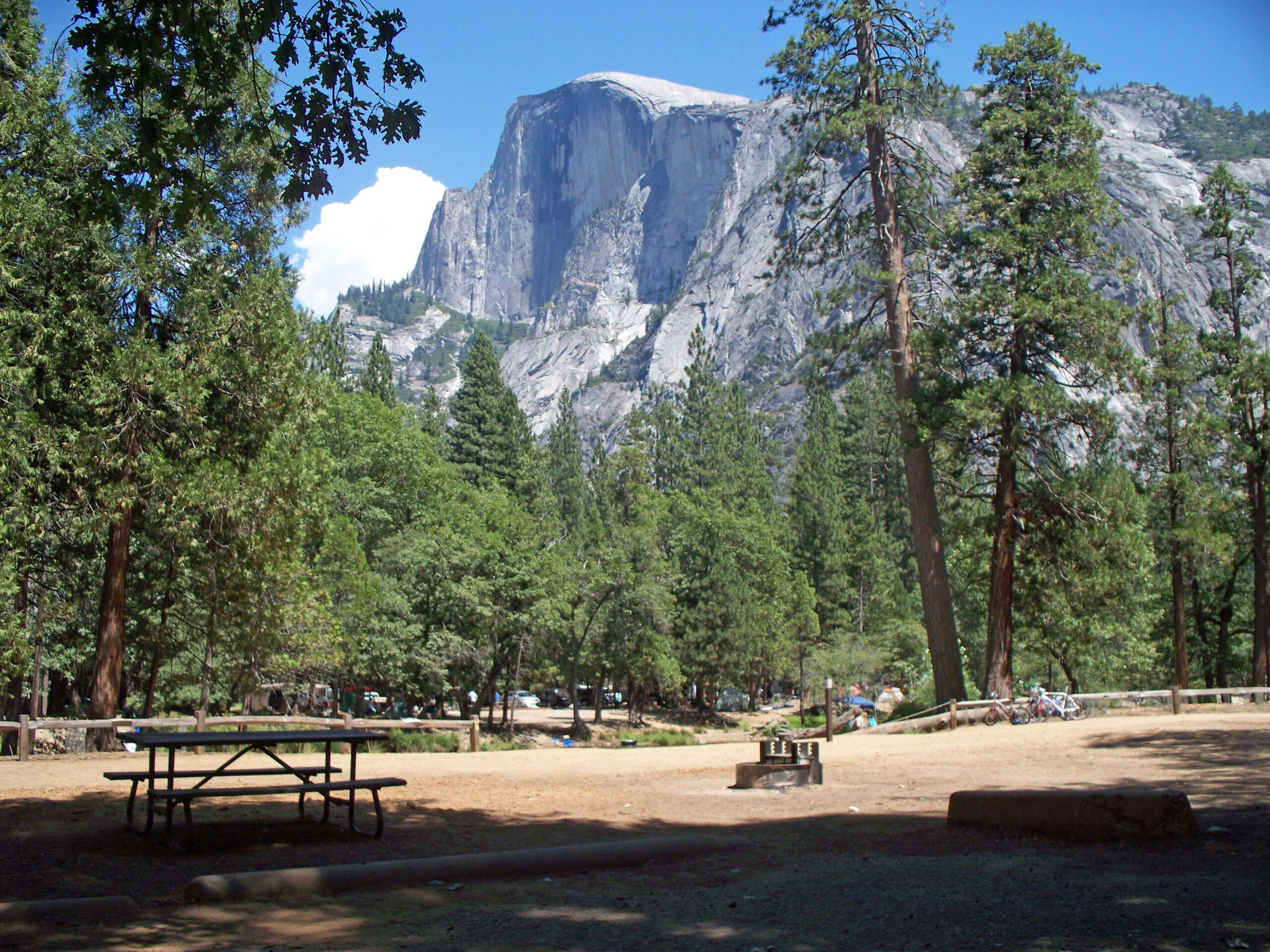
At the heart of Yosemite Valley, Upper Pines Campground has 236 sites. Yet not one of them has electricity. The same is true at nearby Hodgdon Meadow, North Pines, Lower Pines, Wawona at the park’s southern entrance, and Tuolumne Meadows at 8,000 feet. Across Yosemite National Park’s six large drive-in campgrounds, electric hookup sites simply do not exist. That may come as a surprise to travelers arriving in larger RVs, but it reflects a principle the park has maintained for years.
Six Campgrounds, One Shared Feature: No Hookups
According to official National Park Service data, all six campgrounds—Upper Pines, Lower Pines, and North Pines in Yosemite Valley; Hodgdon Meadow on Big Oak Flat Road; Wawona at the southern entrance; and summer-only Tuolumne Meadows—list zero for electricalHookups in their amenities data. Most offer potable water, flush toilets, and dump stations, but none provides electricity. Generator use is also restricted to designated hours that vary by campground, leaving solar panels or lithium batteries as the practical way to spend several days in Yosemite with an RV. Private campgrounds near El Portal or Groveland may offer hookup sites, but they come with the inconvenience of driving to and from the valley each day.
RV Length Limits Vary by Campground
Length limits also differ from campground to campground and should be checked before booking. Upper Pines in the valley allows RVs up to 35 feet and trailers up to 24 feet. North Pines and Lower Pines, also in the valley, are more accommodating, with limits of 40 feet for RVs and 35 feet for trailers. Hodgdon Meadow permits RVs up to 35 feet and trailers up to 30 feet, while Wawona has a 35-foot limit for both RVs and trailers. Summer-only Tuolumne Meadows narrows again to 35-foot RVs and 24-foot trailers. Even within the same park, the campground selected can completely determine what size of equipment travelers can bring. The NPS emphasizes that not every site can accommodate the stated maximum length and recommends entering RV or trailer length directly into the reservation site’s filters. Even within a single campground, heavily wooded interior sites often have narrow access roads that cannot accommodate larger rigs.
The Reservation Rush Begins at 7 a.m. on the 15th
Yosemite campground reservations are released in monthly blocks five months ahead, at 7 a.m. Pacific Time on the 15th of each month. In the peak season from May through September, sites and weekend dates commonly disappear within seconds or minutes of release. North Pines in the valley also uses an early-access lottery, with only selected applicants receiving the first opportunity to reserve. Tuolumne Meadows uses a two-part system: half of its sites are released on the 15th of each month, two months ahead, while the other half are released daily at 7 a.m. beginning two weeks in advance. In 2026, Tuolumne Meadows is scheduled to open only from July 1 through September 28, making its operating season especially short. By contrast, Hodgdon Meadow and Wawona’s A Loop operate without reservations on a first-come, first-served basis in winter, roughly from mid-October through mid-April, making the off-season a more accessible option.
Bear Lockers, Another Rule of Yosemite Camping
Instead of electricity, Yosemite provides bear lockers at every campground. Each site includes a fire ring, picnic table, and a metal food storage locker measuring 35 inches wide, 43 inches long, and 28 inches high. Whether it is a cooler, canned food, or any scented item, it must be stored in the locker rather than in a vehicle. The park explains that once a bear becomes accustomed to the smell of human food, it may repeatedly encounter people and ultimately be euthanized. Valley campground fees run about $36 per site per night, while Tuolumne Meadows group sites are priced at $75 and stock sites at $50. The park entrance fee is $35 per noncommercial vehicle for seven days, $30 for motorcycles, and $20 per person arriving on foot or by bicycle.
In the Valley, Take the Shuttle; Elsewhere, Bring Generator Capacity
Upper Pines, North Pines, and Lower Pines are all served by Yosemite Valley’s free shuttle route, allowing campers to leave their vehicle at the site and walk or bike to Curry Village or Yosemite Village. While there is no electricity, the shuttle significantly reduces the need to drive around the valley. At more distant campgrounds such as Hodgdon Meadow, Wawona, and Tuolumne Meadows, shuttle access is more limited, so travelers should plan for greater generator and battery capacity. From May through September, wood fires are also limited to 5 p.m. to 10 p.m.; the park says the restriction is intended to prevent worsening air quality overnight.
If Planning Now
For travelers seeking a site that same summer, peak-season reservations should be considered effectively gone. Weekdays in fall, Upper Pines during winter when only its first two loops operate, or the first-come, first-served periods at Hodgdon Meadow and Wawona’s A Loop may be worth considering instead. For those prepared to spend a few days without electricity, the valley night sky framed by waterfalls and granite cliffs can more than offset the inconvenience.
Data Source: NPS API (developer.nps.gov) / Recreation.gov RIDB
Photo: NPS Photo / Sheree Peshlakai, National Park Service (nps.gov/yose/planyourvisit/pinescampgrounds.htm)