
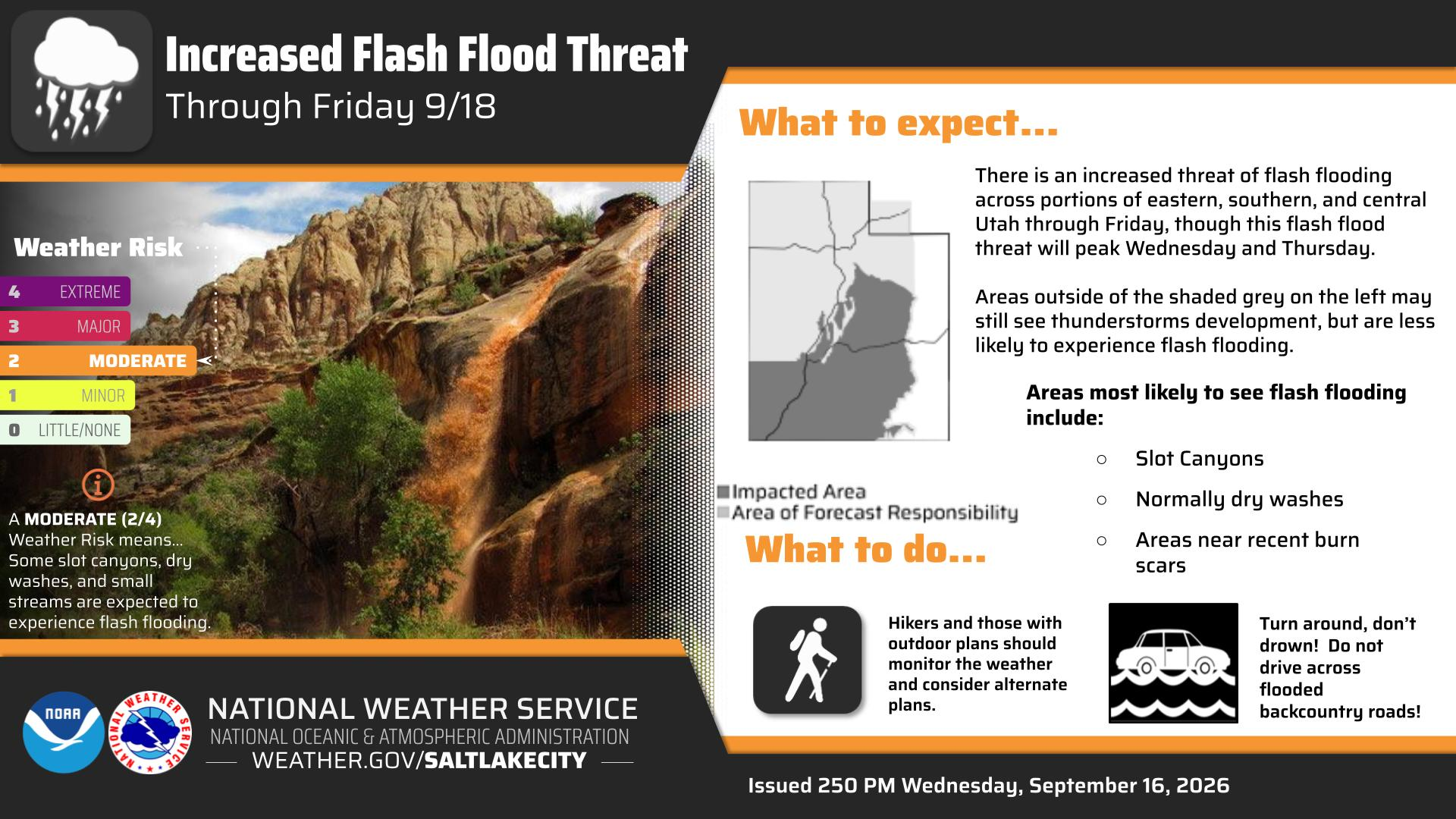
Travelers planning to use Goblin Valley as a base camp while exploring the narrow canyons of the San Rafael Swell should reconsider their afternoon plans for September 17. According to a Flood Watch issued by the NWS Salt Lake City forecast office at 5:48 a.m. Mountain Daylight Time (MDT) that day, showers and thunderstorms redeveloping in the afternoon may continue into the evening, bringing 0.25 to 1 inch of rain per hour. Heavier rainfall is possible beneath the strongest thunderstorms.
This watch does not mean flooding is occurring throughout the area; it means conditions are favorable for flash flooding. Normally dry washes, slot canyons, slickrock areas, and recent burn scars were identified as hazardous terrain. Rather than checking only the sky above the campground, travelers need to include the canyons they plan to visit that day and their access roads within the forecast area.
Areas Affected
The watch covers the San Rafael Swell and Castle Country, the central mountains, and the Wasatch Plateau and Book Cliffs. It specifically lists Goblin Valley, Green River, Price, Castle Dale, Emery, Joes Valley, and Fish Lake, among other locations. It remains in effect through the evening of the 17th, while the end time in the bulletin corresponds to local midnight. Those departing in the afternoon should first check whether a new watch has been extended or upgraded to a warning, rather than relying on the time rain is expected to end.
One local camping option that requires particular distinction is Behind the Butte North. Utah State Parks’ official primitive camping guide explains that this area has four designated sites and recommends four-wheel drive and high ground clearance for access. It does not recommend using the area when rain is forecast because of washes, and specifically says not to drive along washes instead of using the designated road to the campground. This area should not be considered an easy alternative overnight stop for RVs.
The park operations update issued September 12 states that the regular campground and trails are open. However, that does not confirm that all access routes are safe under the new weather conditions on the 17th. The park asks visitors to check the forecast daily because water may remain in canyons, and to consult weather information posted at the visitor center and on-site guidance from staff. Weather alerts and facility operating status must be checked separately.
What RV Travelers Need to Know
The park’s flood safety guidance does not recommend canyon hiking or camping in dry washes when rain is possible. Visitors to Little Wild Horse Canyon and Bell Canyon should not rely only on the forecast for the center of the park; they should select and check the actual trailhead location. If you receive a flash-flood safety alert for the area on your phone, cancel plans to enter canyons and washes.
When changing overnight accommodations, also check the amenities at regular campgrounds. According to the official camping guide, the regular campground at Goblin Valley has no electric hookups. Check reservation availability and the amenities your vehicle requires before choosing an alternative, and do not temporarily park an RV near a wash simply because an open space appears to be available.
If you are already camping in a low-lying area and water begins to rise, do not delay evacuation to protect your gear. NWS flood safety guidance advises moving to higher ground immediately and not entering flooded roads or going around barricades. Even a high-clearance vehicle is not a reason to consider moving water safe. The priority for travel on the 17th is not how much more of the canyons you can see, but whether you can get out of hazardous terrain before rain begins.
Photo: NOAA/NWS Salt Lake City / Original photo page (Public domain)