
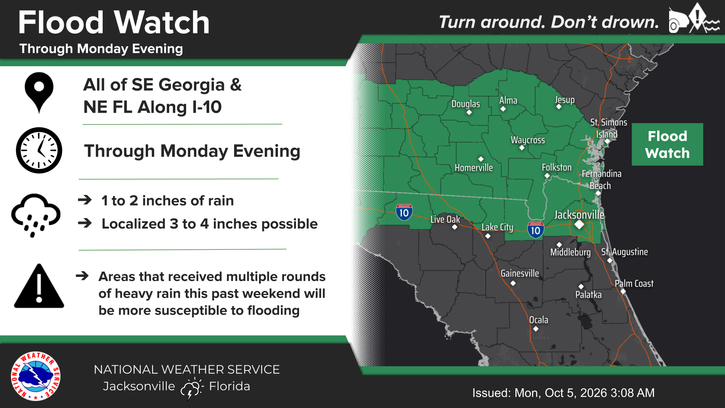
Campers spending the night of October 5 along the Jacksonville coast could not plan the next day based solely on when the rain was expected to end. The Flood Watch updated by NWS Jacksonville at 2:17 a.m. EDT on the 5th remained in effect through 8 p.m. EDT that day, including coastal Duval and Nassau counties. It warned that up to 3 additional inches of rain on already saturated ground could lead to flash flooding.
Stronger northeast winds were expected to follow. The NWS coastal forecast checked on the morning of the 5th called for winds to increase beginning that night, with coastal gusts of 35 to 45 mph expected on the 6th. It also indicated a high risk of rip currents beginning on the 6th, along with possible beach erosion at high tide. The rain threat that day was set to be followed by coastal hazards the next day.
Areas Affected
The Flood Watch included Jacksonville and Fernandina Beach, as well as coastal and inland portions of Duval and Nassau counties. Travelers headed to Little Talbot Island near Jacksonville should check advisories for low-lying areas along their route, not only conditions at their campground. The watch was not an announcement that campground flooding or road closures had been confirmed.
According to Florida State Parks’ facility information Little Talbot Campground is set in a coastal forest, with its western edge bordering a tidal waterway. The campground lists a 30-foot maximum RV length, water service, 20- and 30-amp electric hookups, and a dump station at the exit. Available amenities and same-day access during severe weather should be confirmed separately.
What RV Travelers Need to Know
Before leaving, campers with reservations should review park alerts and their reservation details. The official facility page also includes language about campground renovations, so visitors should not assume a particular loop or site will be available based on a previous stay. If a delayed arrival or on-site conditions are unclear, travelers should first confirm with the park.
NWS flood safety guidance advises people camping in low-lying areas to move to higher ground if water begins rising and to follow evacuation orders immediately. Do not drive around road closures or barriers on flooded roads. Avoid water covering power lines or electrical equipment; once flooding begins, do not enter the water to disconnect hookups.
Beach walks and kayaking plans for the 6th also warranted reconsideration. NWS indicated the possibility of minor tidal flooding at high tide along the Atlantic coast and coastal waterways. The park advises visitors to check beach warning flags. Even if overnight accommodations remain available, do not assume ocean and waterway activities are safe; check the latest coastal forecast before departure and again the following morning.
Photo: NOAA/NWS Jacksonville / Original photo page (Public Domain)