
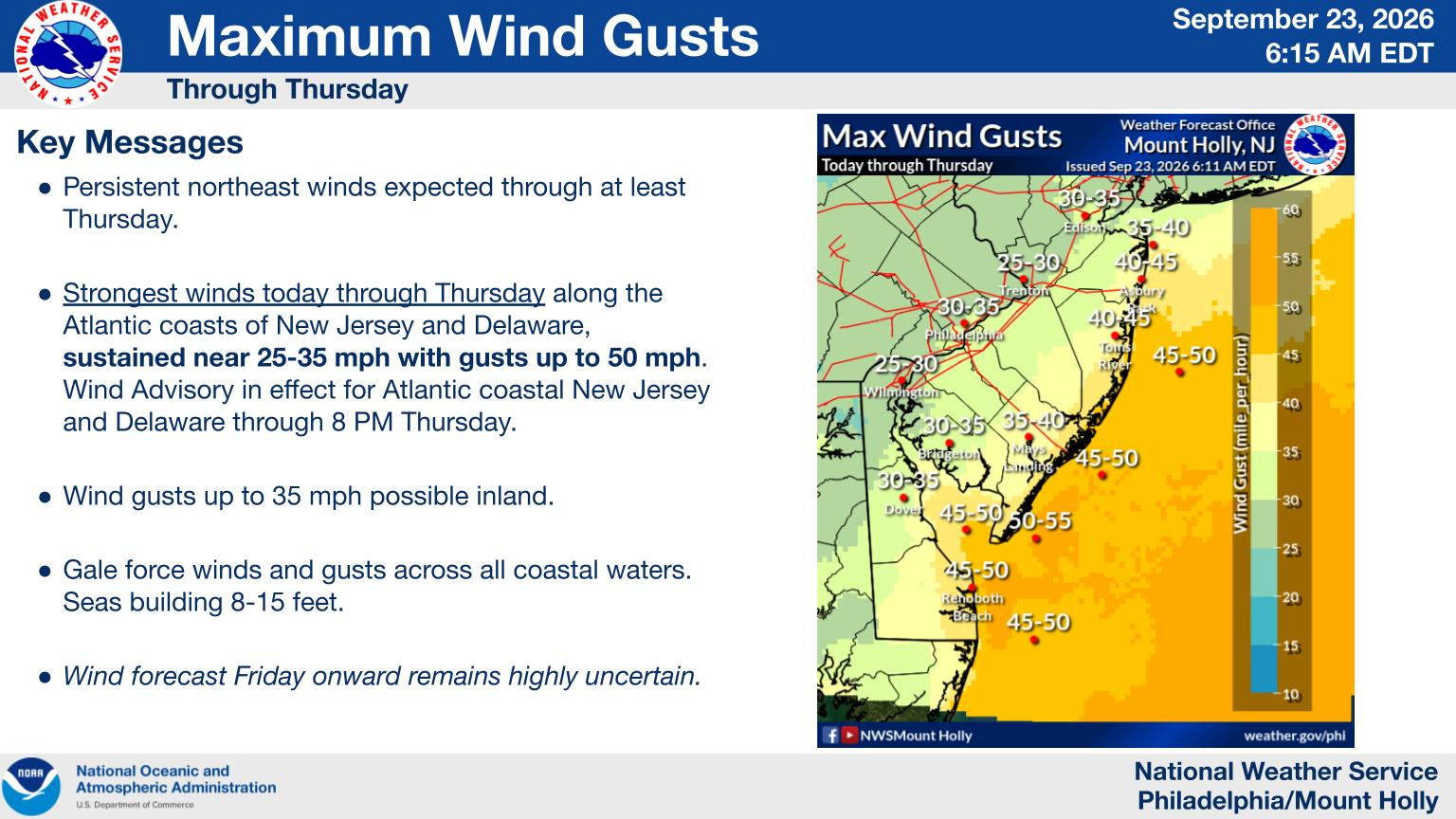
RV travel to Delaware beaches needed to account first for strong crosswinds from September 23 through the evening of the 24th. The Wind Advisory, reaffirmed at 8:41 a.m. EDT on the 23rd by the NWS Philadelphia/Mount Holly office, remained in effect until 8 p.m. on the 24th. Northeast winds were forecast at 25 to 35 mph, with gusts as high as 50 mph. These were forecast winds rather than observed peak speeds, and the NWS warned that driving could be particularly difficult for high-profile vehicles.
Areas Affected
The advisory covered Delaware Beaches and eastern Monmouth, Atlantic Coastal Cape May, Coastal Atlantic, and Coastal Ocean counties in New Jersey. Coastal destinations included Rehoboth Beach, Ocean City, Atlantic City, Long Beach Island, and Sandy Hook. Campers using Cape Henlopen as a base for exploring Delaware beaches needed to consider not only their time in the park, but also travel time to and from the coast.
An NWS wind map updated at 6:15 a.m. on the 23rd focused the strongest winds along the Atlantic coasts of New Jersey and Delaware. Inland gusts up to 35 mph were also possible. Choosing lodging somewhat away from the coast therefore did not necessarily avoid wind impacts, and drivers of high-profile motorhomes or vehicles towing trailers needed to check hourly forecasts along their actual route.
The day’s coastal outlook also cited flooding around high tide, high surf, and strong rip currents. The Wind Advisory’s expiration did not match the end of the coastal flooding risk. The NWS said coastal flooding impacts could continue into the weekend and noted considerable uncertainty in the wind outlook after the 25th. This advisory alone did not establish that any particular campground or access road had closed.
What RV Travelers Need to Know
Those with a Cape Henlopen camping reservation needed to recheck operating notices on the reservation site and park guidance shortly before departure. It was best to ask separately whether check-in was available, whether on-site electric service was operating, and whether beach access was open. The NWS forecast broken tree branches and scattered power outages. An electric hookup reservation alone was not a reason to assume all amenities would remain available during high winds.
At campgrounds, loose outdoor items needed to be secured or moved indoors before winds increased. NWS guidance said drivers encountering strong gusts while traveling should slow down and keep both hands on the steering wheel. Maintain ample distance around vehicles towing trailers, and do not stop where trees or power lines could fall. If a stronger warning was issued, travelers also needed to identify a place where they could shelter in a sturdy building.
If a beach visit and RV travel were part of the same itinerary, travelers needed to check both coastal conditions around high tide and the wind forecast before deciding to leave. Do not drive onto a flooded road to judge its depth or surface condition, and do not go around barricades. Safe access took priority over a scheduled arrival time; if conditions worsened, contact the operator to adjust arrival plans.
Sources: NWS Wind Advisory · NWS coastal weather outlook · Cape Henlopen State Park · NWS wind safety guidance · NWS flooded-road guidance
Photo: NOAA/NWS Philadelphia/Mount Holly / Original photo page (Public domain, no copyright is claimed in the original government work · Terms of use)