
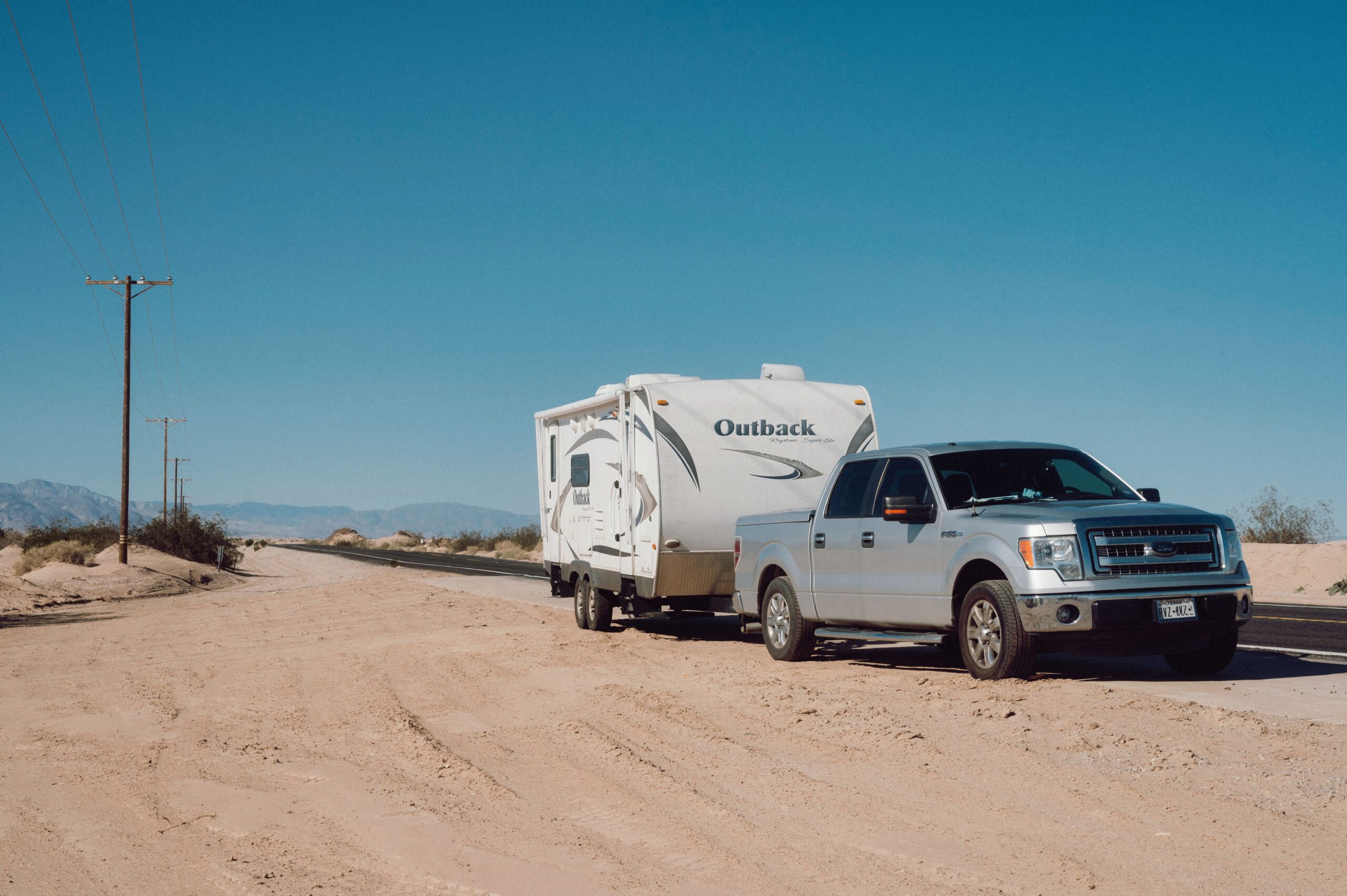
New York requires brakes once a trailer exceeds 1,000 pounds. The threshold is 1,500 pounds in California and Nevada and 2,000 pounds in Kansas and Ohio. Texas, by contrast, allows towing without brakes up to 4,500 pounds, while Massachusetts sets the limit at a full 10,000 pounds. That means whether a brake controller is legally required can change as soon as you cross a state line with the same trailer.
It Depends on Loaded Weight
One commonly overlooked detail is that the relevant weight is the trailer’s loaded weight, not its empty weight. Camping gear, tools, tie-down equipment, and fuel can push a trailer over the threshold sooner than expected. If it is unclear whether your trailer exceeds a state’s limit, installing a brake controller is the safer choice. Most RV trailers and fifth wheels already exceed even the lowest threshold by a wide margin, making a controller less of an option than a necessity.
Time-Delayed vs. Proportional: What’s the Difference?
Electronic brake controllers generally fall into two categories. A time-delayed controller increases the braking signal sent to the trailer based on how long the driver holds the brake pedal. Its drawback is that it cannot distinguish between light braking on a gentle downhill grade and hard braking in an emergency stop. An inertia-based, or proportional, controller instead senses how quickly the tow vehicle is slowing and adjusts trailer braking force accordingly. When the tow vehicle stops hard, the trailer brakes respond more firmly; when it slows gradually, they apply more gently. Proportional controllers are widely regarded as providing smoother, more predictable braking and are recommended for most RV travelers.
What to Know Before Installing One
A brake controller is installed inside the tow vehicle and connected to the trailer’s electric brake wiring. Exact installation procedures vary by manufacturer and vehicle model, so the wiring should follow the instructions provided with the product. Installation is not the point to immediately set out on a long trip. The controller’s output must be adjusted through several stops at low speeds of about 5 mph in a wide, empty lot or driveway. The goal is not to lock the trailer wheels, but to find the setting at which the trailer slows naturally without pushing the tow vehicle. If the setting is too low, the trailer can feel as though it is pushing from behind; if it is too high, the trailer wheels may lock and skid first.
Readjust It Every Time You Load Up
Do not continue using the same output setting indefinitely. A trailer loaded with camping gear and a full water tank weighs considerably more than one being moved nearly empty. When the weight changes, the appropriate braking output changes as well. Before a long trip, it is wise to test the setup again at low speed for that day’s load. This check is especially important before mountain roads or steep grades.
In the End, Safety Depends on the Setting
Installing a brake controller is not the final step. Regardless of the type you choose—or whether the law requires one—real-world safety depends on how accurately its output is adjusted. When hitching up a new trailer for the first time, or towing again after a long break, it is worth making several low-speed stops in an empty lot. Those few minutes can make a major difference in how the trailer responds on a steep descent or during a sudden stop.
Photo: Alfo Medeiros, Pexels (pexels.com/photo/silver-car-with-trailer-on-arid-road-15823488/)