
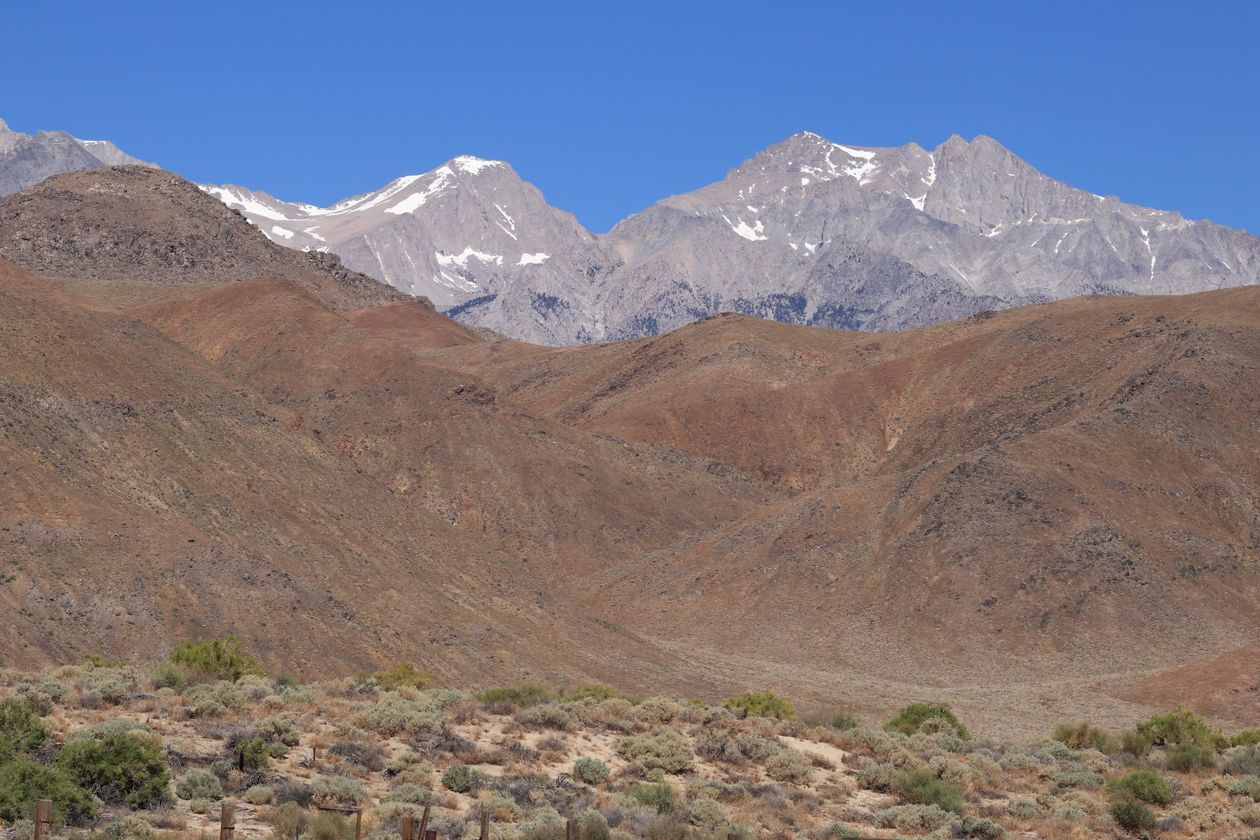
California’s U.S. Route 395 follows the eastern foot of the Sierra Nevada through Owens Valley. From Lone Pine through Independence and Bishop to Mammoth Lakes, the White Mountains rise to the left and the Sierra crest stands to the right, making this one of the region’s standout RV routes. Most campgrounds, however, sit above 8,000 feet, and reservations fill quickly during the summer high season.
Extending the trip from Bishop to State Route 203, which branches toward Mammoth Lakes, adds many more campgrounds worth considering on a round-trip itinerary. Even in summer, temperatures along the Sierra crest can drop sharply in the morning and evening, making this a route where warm clothing and a sleeping bag are essential—the opposite of low-elevation Death Valley.
Lone Pine Area — Alabama Hills and Nearby
Near Lone Pine, free dispersed camping is available in the BLM-managed Alabama Hills, a well-known Western film location with relatively well-maintained access roads. For a site with more amenities, the BLM-operated Tuttle Creek Campground offers spacious sites, good views, and generally better cell service. Inyo County’s Diaz Lake Campground is another nearby option.
Alabama Hills is also popular with photographers for its unusual landscape of rounded granite boulders. Most roads are unpaved, but many have firm enough surfaces for standard RVs, and the area is one of the few places where visitors can see both the Sierra crest and the White Mountains at once. As a free dispersed camping area, however, it has no amenities, so campers must plan for their own water supply and trash disposal.
Past Independence, the road gradually begins gaining elevation. The snowcapped Sierra crest remains visible through the right-side windows for much of the drive, making it an especially enjoyable stretch behind the wheel. Drivers of larger RVs should put safety first before pulling onto a shoulder for photos.
Bishop Area — Options With Hookups
More campgrounds with hookups become available around Bishop. Eastern Sierra Tri-County Fairgrounds has full hookups, clean restrooms, and convenient access to town. Brown’s Town is known for its cozy, well-shaded setting, while Highlands RV Park offers full hookups, restrooms, and laundry facilities suitable for longer stays.
Bishop also has several private campgrounds beyond these three, offering a broad range of choices. Travelers seeking full hookups can start with parks closer to town, while those prioritizing shade and a quieter setting may prefer options farther out. Reservations in this area also fill quickly during the summer high season, so it is safest to secure a site at least several weeks ahead.
Mammoth Lakes Area — Three Inyo National Forest Campgrounds
The Mammoth Lakes area has a dense concentration of campgrounds managed by Inyo National Forest. Sherwin Creek Campground, 2 miles from Mammoth Lakes, has 85 sites and is reached by turning from U.S. Route 395 onto State Route 203, then taking Old Mammoth Road to Sherwin Creek Road. It is popular with anglers, hikers, and off-road users. About 34 miles north of Bishop, Convict Lake Campground has 48 sites beside Convict Lake and offers exceptional scenery. Coldwater Campground in the Lake Mary basin has 74 sites.
All three are managed by Inyo National Forest and can be reserved through recreation.gov. Because of their high elevation, the camping season is relatively short, running from late summer into early fall, so it is wise to reserve promptly once travel dates are set.
All three campgrounds offer good access to fishing and hiking. Sherwin Creek is close to town, making grocery runs convenient; Convict Lake sits directly beside the lake and is well suited to kayaking or canoeing; and Coldwater, farther into the Lake Mary basin, tends to be comparatively quiet. Access roads to all three are better suited to midsize trailers or camper vans than to large RVs, so travelers towing a large motorhome should check road width and turning radii in advance.
Allowing at least 3 nights and 4 days makes for a more relaxed trip along the full route. A common itinerary is to spend a night each in Lone Pine or Bishop while exploring nearby trails, then stay about 2 days in Mammoth Lakes to take in the lake area at an easy pace. If campground reservations are unavailable, a private RV park in Bishop can serve as a base for day trips to Mammoth Lakes or Alabama Hills.
What RV Travelers Need to Know
U.S. Route 395 itself is wide and well paved, but the side roads leading toward Mammoth Lakes include many steep climbs and descents. Those driving a large RV or towing a trailer should check engine braking and low gears in advance, and inspect fuel and coolant levels before departure. Nighttime temperatures at high-elevation campgrounds can fall significantly, so heating equipment is worthwhile even in midsummer.
In winter, snow can close some side roads. Travelers visiting from late fall through early spring should check Caltrans or Forest Service road-condition notices before leaving. In contrast, daytime temperatures can become quite hot in the lower-elevation Owens Valley stretches during midsummer, so carrying ample drinking water and preparing for cooling are recommended.
Lone Pine, Bishop, and Mammoth Lakes are the only larger towns along the route for fuel and groceries, so it is important to stock up before traveling between them. Cell service also weakens in many areas outside town, and downloading offline maps ahead of time can help in unexpected situations.
Photo: EJ Merl, https://www.pexels.com/photo/scenic-view-of-mountains-under-a-blue-sky-26574632/