
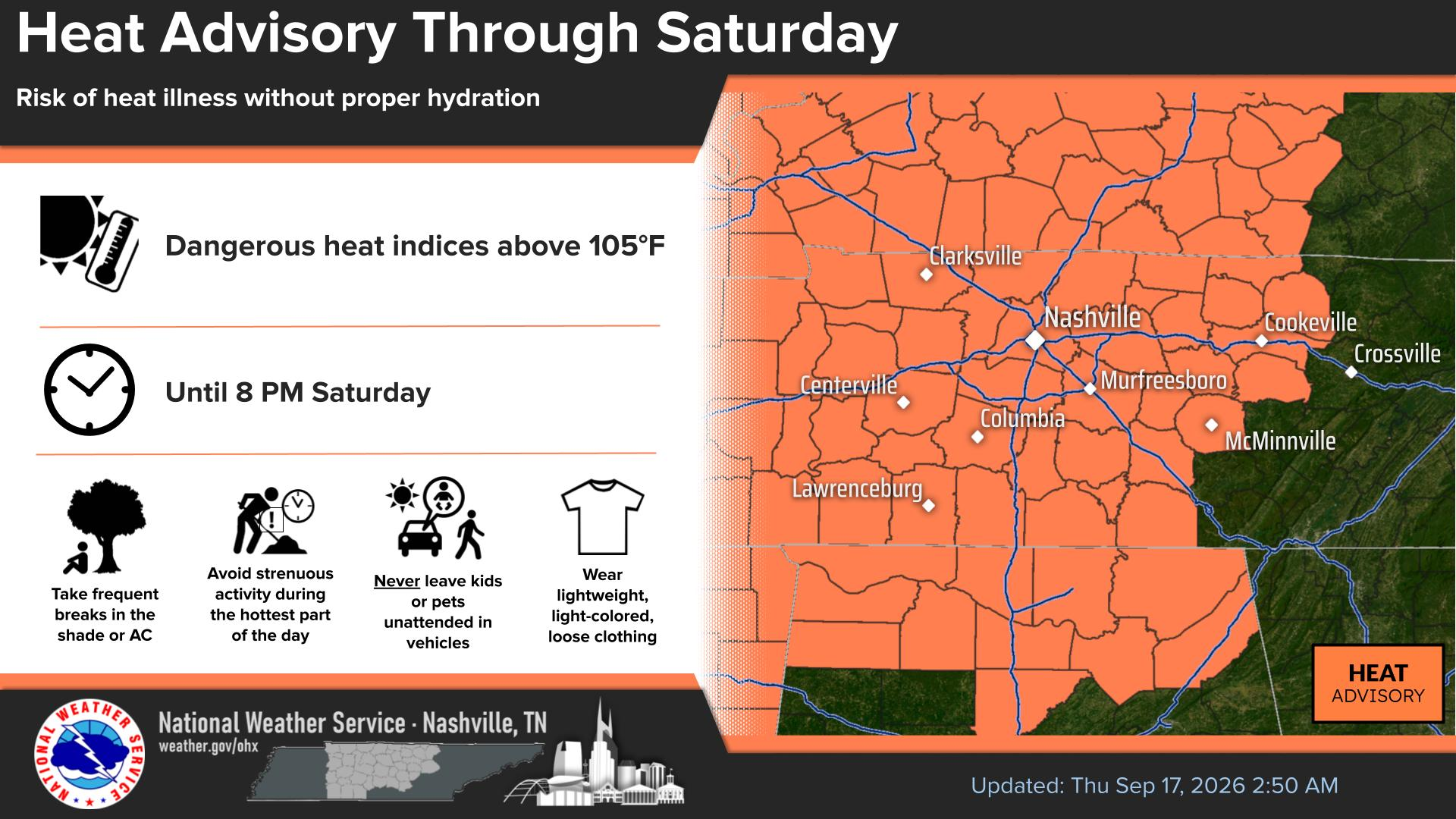
Even September camping by a lake near Nashville requires midsummer-level air-conditioning plans. The NWS Nashville forecast office’s September 17, 6:25 a.m. CDT forecast discussion lists a Nashville daytime high of 98°F and an overnight low of 76°F. A Heat Advisory remains in effect for most of Middle Tennessee until 8 p.m. Saturday, September 19.
NWS alert updated at 10:24 p.m. on the 16th says heat index values in the affected area could reach as high as 108°F. This is the upper end of the expected heat index at some locations in the area, not an actual observation at every campground in Nashville. With high humidity added to the mix, air-temperature numbers and the presence or absence of shade alone make it difficult to determine safe times for outdoor activities.
Areas Affected
The advisory includes Davidson County, where Nashville is located, as well as Wilson, Sumner, and Rutherford counties. It is also an advisory to check when traveling through Gallatin, Lebanon, Mount Juliet, Hendersonville, and Murfreesboro. NWS expected daytime temperatures west of the Plateau to generally reach the mid-to-upper 90s°F, with some locations exceeding 100°F. Overnight temperatures may remain in the low 70s°F in many areas, potentially providing insufficient relief from the heat accumulated during the day.
Percy Priest Lake, a destination for RV travelers, is about 10 miles east of downtown Nashville. Recreation.gov’s Seven Points Campground information describes 59 shaded sites, as well as drinking water, a dump station, and shower facilities. The lake and shade are trip advantages, but they cannot be considered a substitute for air-conditioned indoor space during this heat wave.
Checking site-specific amenities makes preparation more concrete. For example, Seven Points Site 50 provides 50-amp electric service and a water hookup, and lists a maximum RV/trailer length of 45 feet. There is no sewer hookup. This information describes site amenities and does not mean the site is available today, so before leaving, check availability by date and confirm that the site fits your vehicle.
What RV Travelers Need to Know
After arriving at the campground, it is better not to try to finish all hookup and setup tasks at once; allow for cooler times of day and rest breaks. NWS heat safety guidance recommends moving strenuous activities to the coolest part of the day, reducing sun exposure, and resting in air-conditioned places. Before traveling, identify an air-conditioned space where you can stay if your RV’s cooling is not adequate.
Children and pets must not be left alone in a parked vehicle. NWS explains that cracking the windows does not sufficiently slow how quickly the vehicle’s interior heats up. Even an outing that seems likely to be brief, such as a lakeside walk or a trip to the store, requires deciding in advance where companions will wait. Bring water and take frequent breaks, but people under medical instructions to limit fluid intake should follow those instructions.
It is also difficult to expect rain to bring relief from the heat anytime soon. The NWS forecast discussion on the 17th put the chance of meaningful rain across a broad area through Saturday at low, and also mentioned the possibility that the heat alert could be extended through Sunday. Because an extension was not confirmed, weekend campers should check for updated alerts. For this lakeside itinerary, it is more realistic to prioritize air conditioning and rest time rather than add more afternoon outdoor activities.
Photo: NOAA/NWS Nashville / Original photo page (Public domain)