
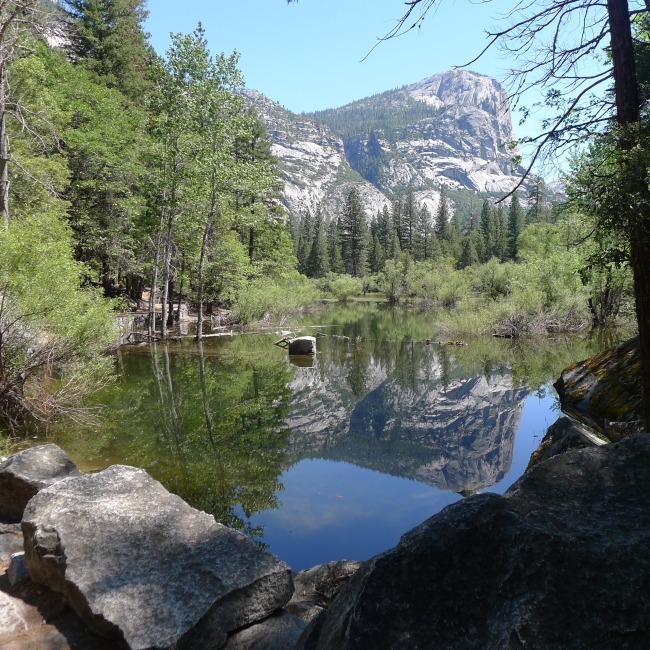
Yosemite Valley was forecast to be sunny on Tuesday, October 27, with a daytime high of 66°F and an overnight low of 39°F. The forecast, updated by the NWS at 4:56 a.m. Pacific Daylight Time that day, pointed to relatively mild daytime weather through the week along with a chance of weekend precipitation. RV travelers planning to stay for several days needed to check not only the clear weather on the first day, but also late-October campground operational changes and the forecast for their travel dates.
Areas Affected
This forecast applied to Yosemite Valley at an elevation of 4,760 feet. On the 27th, east winds of 5 to 10 mph were expected to shift to southwest winds in the afternoon, with gusts up to 15 mph. East-northeast winds of 5 to 10 mph were forecast overnight. Wednesday, the 28th, was forecast to be sunny with a high near 68°F, followed by a mostly cloudy night with a low around 43°F.
There was a 20% chance of rain after 11 p.m. Thursday, the 29th, increasing to 40% after 11 a.m. Saturday, the 31st. Saturday’s high was also forecast to fall to 57°F. This represented the precipitation potential at the time, not a confirmed forecast of rain throughout the weekend. The point forecast was valid from 5 a.m. on the 27th through 6 p.m. on November 2, with the expiration time listed in Pacific Standard Time.
NPS road information updated on the 23rd stated that Tioga Road and Glacier Point Road were open, but overnight parking along roadsides and in parking areas was prohibited. Valley forecasts alone should not be used to judge high-elevation travel conditions, and an open-road status did not guarantee passage during later severe weather. The park directed visitors to check the latest road conditions by calling 209-372-0200, selecting option 1 and then option 1 again.
What RV Travelers Need to Know
Under the official 2026 schedule, North Pines ended its season on October 26 and Lower Pines on October 19. Upper Pines, open year-round in the valley, was listed for RVs up to 35 feet and trailers up to 24 feet, though travelers still needed to verify the vehicle capacity of their individual site. Camp 4 was also open year-round, but it was walk-in, tent-only camping and could not serve as an RV overnight site.
At Wawona Campground, Loops B and C were scheduled to end their season on the 26th, while the reservation period for Loop A was extended through November 29. The final reservable night was the 28th. During seasonal campground transitions, travelers should not assume the entire park closes at once or that every area switches to first-come, first-served; they needed to check the specific loop and dates they intended to book.
Even open campgrounds did not provide electric, water, or sewer hookups. The Upper Pines dump station was listed as available year-round, and generators could be used only from 7 to 9 a.m., noon to 2 p.m., and 5 to 7 p.m. For trips with overnight temperatures in the 30s, travelers should not prepare on the assumption that they could run a generator all night.
Extra time was also needed for travel within the valley. El Capitan Bridge construction could cause delays of about 15 minutes on weekdays from 7 a.m. to 7 p.m. through December, and weekday 15-minute delays were also listed for Big Oak Flat Road. Before leaving, travelers should compare the NWS forecast again with NPS road and campground information, and remember that if a reservation cannot be confirmed, roadsides or general parking areas cannot be used as substitute overnight accommodations.
Sources: NWS Yosemite Valley point forecast · Current NPS road and campground information · NPS 2026 campground operations, vehicle-length, and generator rules
Photo: National Park Service · Original photo and terms of use · Public Domain · Taken 2017-06-02.