
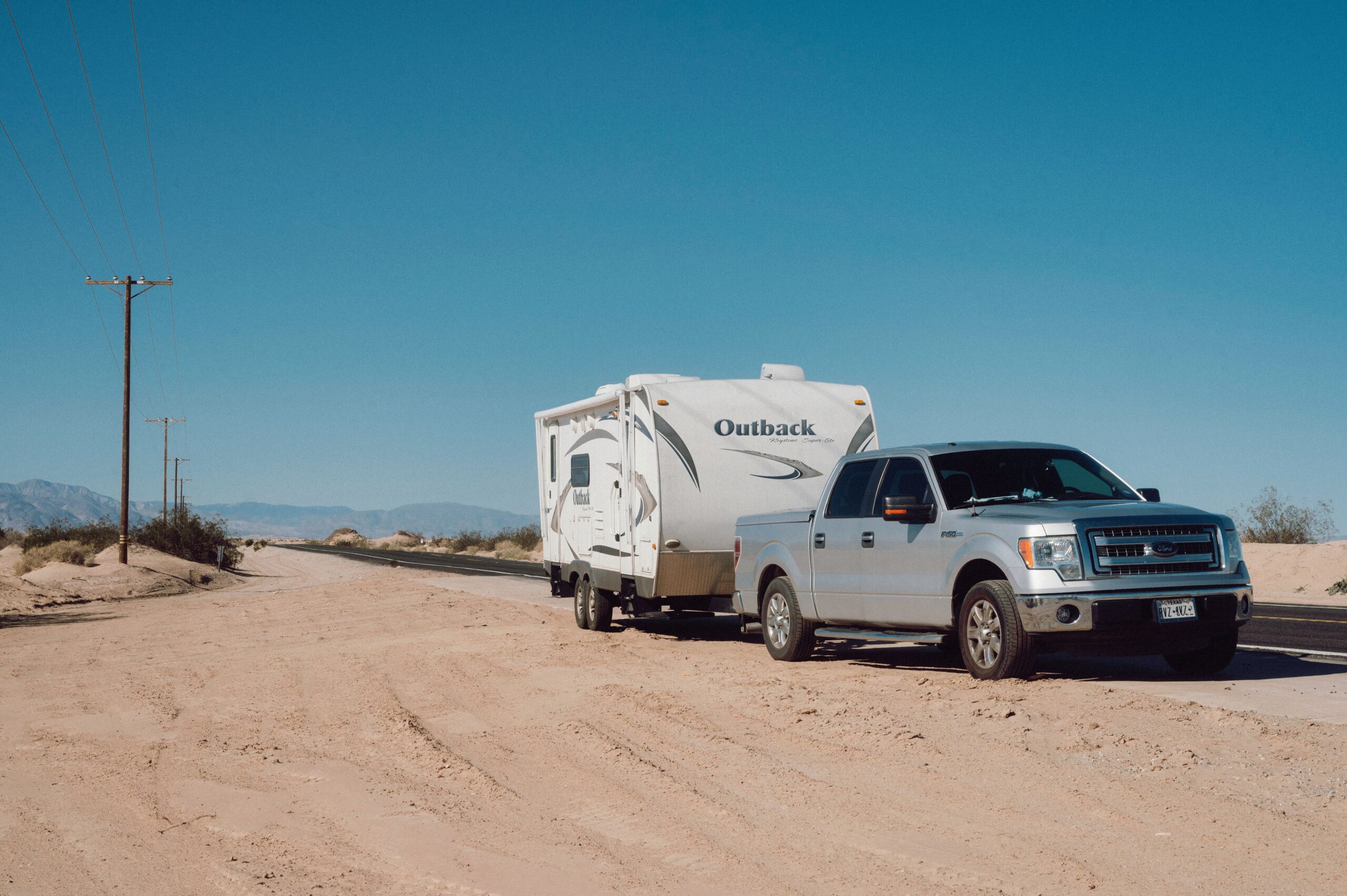
Once the kingpin settles over a pickup truck’s bed, the towing experience changes completely from that of a conventional trailer. Because a fifth wheel carries its center of gravity over the truck bed, it is often considered more stable than a bumper-pull trailer. That does not mean it can be towed without preparation, however. First-time fifth wheel owners have several essential items to address before setting out.
Start by checking the tow vehicle’s payload numbers
Because a fifth wheel places the full kingpin load in the truck bed, owners need to check the truck’s payload rating as well as its towing capacity. Payload ratings vary by truck model and model year, so a safe starting point is to weigh the trailer in its actual loaded condition—including food, water, and gear—at a scale and compare that number with the truck’s specifications. It is not uncommon for the real load to exceed the figures assumed on paper.
Make a habit of hitching up on level ground
Hitching a fifth wheel on a slope can create a risk that the kingpin and hitch plate will not engage properly. When possible, choose the flattest available ground for hitching; if perfectly level ground is unavailable, select the most level section you can find. After connecting, get out of the vehicle and visually confirm that the pin is fully locked and that the safety chains and brake cable are properly attached.
Set the brake controller for the trailer’s weight
Leaving a trailer brake controller set too low can increase stopping distance, while setting it too high can make the trailer feel as though it is pushing during hard braking. Before departure, conduct several low-speed braking tests and adjust the controller’s setting to match the load being carried. Tire pressure should also be set to the cold-pressure specification, in psi, listed by the trailer manufacturer.
Practice backing up using side mirrors and a backup camera
A fifth wheel turns differently from a conventional trailer, so it is wise to practice backing into a tight campground site beforehand in a wide, quiet parking lot. Blind spots that are difficult to judge with side mirrors alone should be covered with a backup camera or directions from a passenger. Even if the first few attempts take time, resisting the urge to rush is one of the surest ways to avoid a contact incident.
Checking the numbers is the foundation of safety
Reducing accidents while towing a fifth wheel ultimately comes down to a habit of checking the numbers rather than relying on instinct. Establishing a routine that checks payload, tire pressure, brake strength, and kingpin engagement in the same order before every departure makes it much easier to respond to changing road conditions. The awkwardness of towing a fifth wheel for the first time becomes familiar with repeated inspections.
Photo: Alfo Medeiros, Pexels — https://www.pexels.com/photo/silver-car-with-trailer-on-arid-road-15823488/