
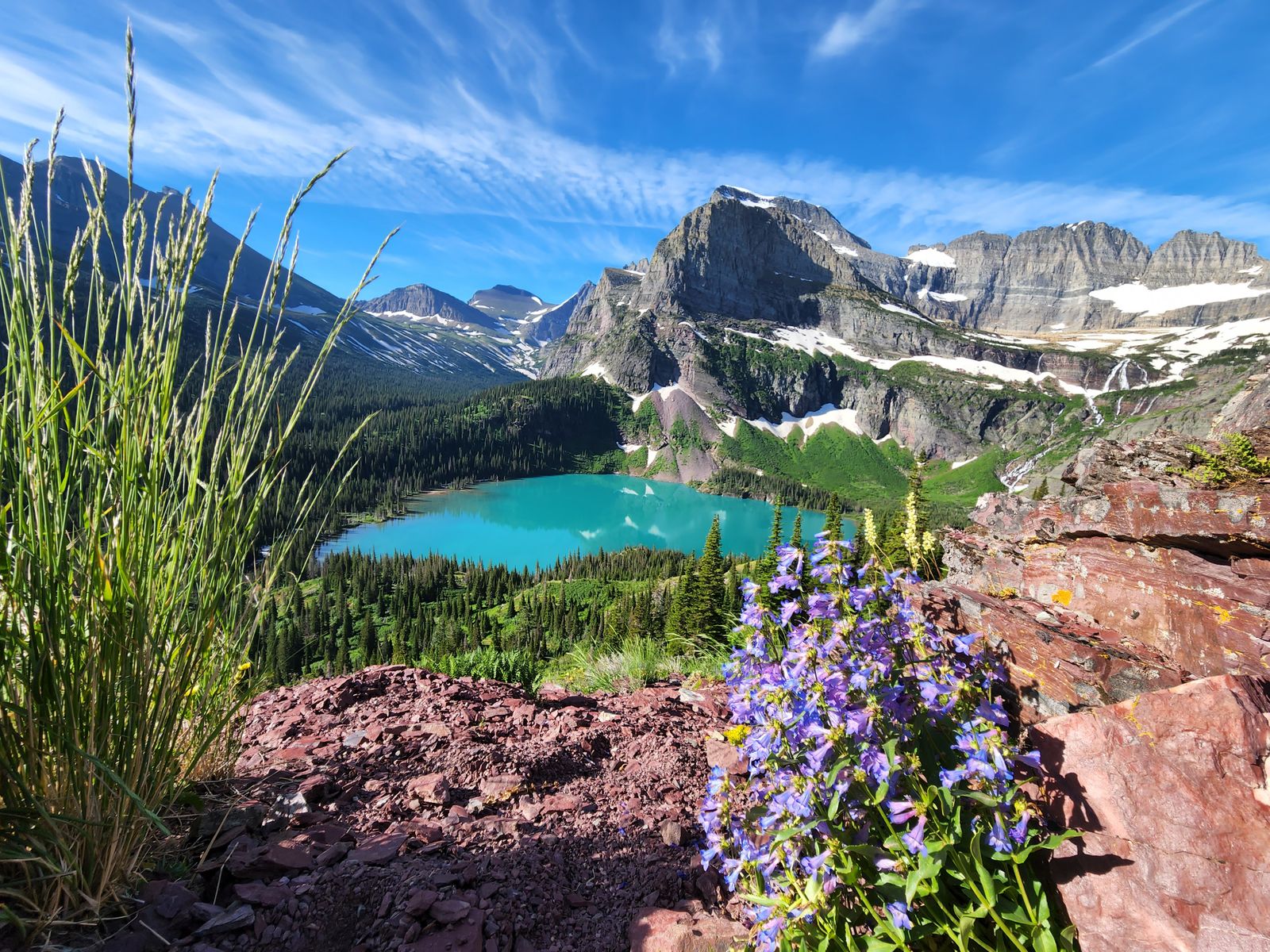
In northwestern Montana, Going-to-the-Sun Road crosses Glacier National Park for 50 miles. The road was fully open for the 2026 season, with Logan Pass accessible from both the West Glacier entrance on the west and the St. Mary entrance on the east. But the road has size limits, and RVs exceeding them cannot even travel halfway across.
Between Avalanche Creek and Rising Sun, 21 Feet Is the Limit
The standards published by park management are clear. Vehicles and vehicle combinations longer than 21 feet, including bumpers, or wider than 8 feet, including side mirrors, are prohibited between Avalanche Creek and Rising Sun. This includes a truck-and-trailer combination—the combined length of a pickup truck and travel trailer. A fifth wheel is no exception: the entire length, from the truck’s front bumper to the trailer’s rear bumper, must be measured.
There is also a height restriction. Vehicles over 10 feet tall may strike rock overhangs on the westbound descent from Logan Pass to The Loop. Livestock vehicles carrying horses and trailers may travel only as far as Packers Roost on the west side or Siyeh Bend on the east; they are not allowed beyond those points.
For campers with large rigs, this stretch is a no-go zone with no practical alternative. The 21-foot limit is a narrow gate that admits only many smaller trailers and camper vans. For larger RVs, the realistic option is to park at West Glacier or St. Mary and use the park shuttle, which operates during the summer. Because shuttle service is limited to the summer peak season, visitors should check whether it will be running for their travel dates.
A Park Without a Single Hookup
Glacier National Park Service data reveal one notable fact: none of the park’s 13 campgrounds has electric hookups. That applies to Apgar, Avalanche, Bowman Lake, Cut Bank, Fish Creek, Kintla Lake, Logging Creek, Many Glacier, Quartz Creek, Rising Sun, Sprague Creek, St. Mary, and Two Medicine.
Without a generator, it is not possible to fully run a refrigerator, air conditioner, and battery charging system. That single detail, often absent from campground reservation pages, changes the packing list for a Glacier trip. An RV without solar panels, extra batteries, or a propane generator can run low on power within a day or two in the park. Even when using a generator, campground rules often limit the hours of operation, so it is safest to confirm them with the host at check-in.
Fish Creek Allows Up to 35 Feet
Among the 13 campgrounds, Fish Creek Campground accommodates the largest RVs. Eighteen of its 178 sites can accommodate RVs or truck-and-trailer combinations up to 35 feet. The nightly fee is $30, and advance reservations are available through the reservation system. However, C Loop is designated a no-generator area, so travelers should confirm which loop their assigned site is in ahead of time.
By contrast, popular campgrounds such as St. Mary and Rising Sun often have shorter length limits at individual sites. Check the length limit for each site number before making a reservation. Even if an RV meets the 21-foot road limit, the campground site itself may accept only a shorter rig. Arriving in a large RV and having to change site assignments at the campground entrance can be especially difficult during peak season.
What to Check Before Leaving
The park’s alert page noted that, because of construction at Two Medicine Campground in 2026, the North Shore Trailhead was accessible only by a detour. Travelers whose itinerary passes through the construction area needed to check ahead.
Another point to plan for is that there are no gas stations within park boundaries. Fuel must be purchased in communities outside the west or east entrances, and summer parking fills early in the morning, so arriving at a destination around sunrise is the better approach. As of 2026, no separate vehicle reservation was required to drive Going-to-the-Sun Road, but limited parking remained a separate issue from the reservation system.
Visitors were also repeatedly advised not to throw food waste out vehicle windows. Something as small as an apple core or coffee grounds can draw wildlife toward the road, leading to roadkill. Because bears are common in the area, food must be stored in sealed containers.
The 21-foot line, campgrounds without hookups, and Fish Creek’s 35-foot maximum: remembering those three numbers covers much of the preparation for an RV trip to Glacier.
Data Source: NPS API (developer.nps.gov) / Recreation.gov RIDB
Photo: Heather R, Pexels (https://www.pexels.com/photo/mountain-landscape-with-emerald-lake-17187982/)