
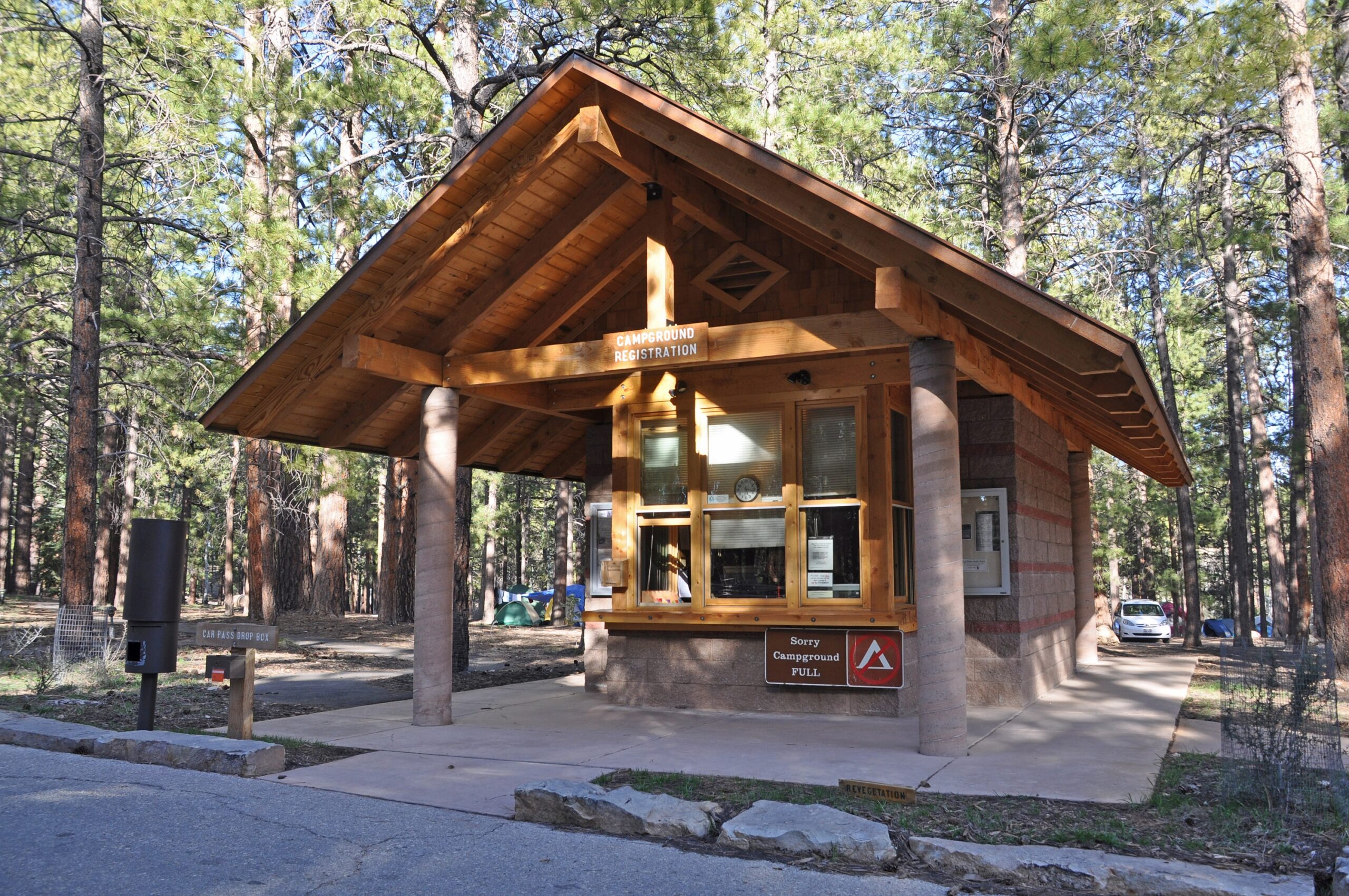
Burn scars remain beyond the registration office’s log roof. This is the Grand Canyon’s North Rim, where the Dragon Bravo Fire in summer 2025 destroyed the lodge, visitor center, and roughly 70 lodging units. On June 1, 2026, the adjacent campground reopened.
After the Wildfire
The Dragon Bravo Fire, sparked by lightning on July 4, 2025, was initially small enough for initial-attack crews to handle. Then, on the afternoon of July 11, unexpected gusts pushed the fire across containment lines. NPS staff and contractor personnel were ordered to evacuate, and aerial reconnaissance the next day confirmed that most facilities—including Grand Canyon Lodge, the visitor center, and 11 employee residences—had been destroyed. A chlorine-gas leak at the North Rim water treatment facility occurred the same day. The fire continued into September, burning more than 150,000 acres, and the North Rim remained closed for the rest of the 2025 season. The lodge ruins were removed that November.
The Campground Is Open, but With Limits
On May 15, 2026, paved North Rim roads including Highway 67, Cape Royal Road, and Point Imperial Road reopened first. North Rim Campground followed on June 1, with reservations handled through Recreation.gov. But this campground was not built with large RVs in mind. Set at 8,200 feet among pine and aspen forest, it does not accommodate large, tall vehicles. Recreation.gov’s site-specific information lists a maximum vehicle length of 21 feet for one standard site, No. 049; that measurement includes the RV or trailer and tow vehicle combined. Curving access roads and narrow passages between trees also mean trailers may not be able to extend slide-outs or awnings at some sites.
To continue beyond the campground toward Cape Royal Scenic Road, the Widforss Trailhead, or the North Kaibab Trailhead, vehicles must be no longer than 22 feet. Anyone planning this route in a rental RV should check that number first.
Why You Must Manage Without Water
The North Rim waterline and treatment facilities were severely damaged during firefighting operations. The National Park Service announced that no potable water would be available anywhere on the North Rim during the 2026 season, including at the North Kaibab Trailhead. Campers need to bring in their entire supply of drinking water. The same is true for lodging: there is nowhere to stay overnight on the North Rim during the 2026 season, whether in the lodge or a cabin. Visitors must use lodging outside the park, such as in Jacob Lake.
Areas Affected
It is August, in the heart of Arizona’s monsoon season. In watersheds stripped of vegetation by fire, a single heavy rain can sharply increase runoff. Much of the drainage flowing to the Colorado River—including House Rock Wash, North Canyon and South Canyon, Nankoweap Creek, and Bright Angel Creek—falls within the burn area. Some drainages run for more than 13 miles: rain falling on a ridge may take two or three hours to reach the river, while torrents can arrive in just minutes near burned terrain. Hikers and campers may encounter sudden muddy water or debris flows carrying trees and rocks. During monsoon season, it is best not to let clear skies create a false sense of security near canyons or washes.
Even One Campsite Comes With Conditions
At Site 049, up to two vehicles are allowed, occupancy is limited to six people, and the paved driveway is pull-through. Check-in is at noon and check-out is at 11 a.m., similar to other national park campgrounds. A fire ring with grill and a picnic table are standard, and flush toilets are nearby. But these amenity details reflect normal operating information; for the 2026 season, potable-water service remains separately restricted because repairs to the treatment facilities are unfinished. Some tent-only sites are walk-in sites, so RV campers should filter by site type during the reservation process to avoid an unsuitable booking.
What Remains—and What Does Not
Aerial reconnaissance found that the general store, campground, gas station, and some cabins and employee residences escaped the flames. Grand Canyon Village on the South Rim continues normal operations, unaffected by this fire. The full North Kaibab Trail is again open to hikers, but stock use is suspended for the season and restoration work is expected to cause delays in some sections. Bright Angel Point Trail, Widforss Trail, and Transept Trail remain closed.
The North Rim has always drawn far fewer visitors than the South Rim and has long been known as a quiet place to camp. With no lodge fireplace or viewpoint lounge, that quiet is even more pronounced. The responsibility for managing without water or lodging, however, rests entirely on campers’ preparation.
The Same Canyon, but a 210-Mile Drive Away
The North Rim and South Rim face each other across the same Grand Canyon, but there is no way to cross directly through the canyon. From Grand Canyon Village on the South Rim, the drive to the North Rim is about 210 miles. The canyon is roughly 10 miles wide as the crow flies, but the actual trip is more than 20 times that distance. That long drive has always made the North Rim the quieter side, visited by only a small share of Grand Canyon visitors. With fewer facilities after the fire, its isolation is even more apparent.
Three Things to Check Before Reserving
For a North Rim camping trip, it is safest to check three things in order. First, on Recreation.gov, confirm that the maximum vehicle length for the site you want exceeds the combined length of your RV and tow vehicle. Second, if you plan to travel beyond the campground to viewpoints such as Cape Royal or Point Imperial, check the 22-foot limit again. Third, build your itinerary on the assumption that neither drinking water nor lodging will be available inside the park. With those three points settled in advance, camping itself can still feel much like it did in previous years, even where the lodge once stood.
Photo: NPS Photo by Michael Quinn, National Park Service (nps.gov/media/photo/gallery.htm?id=6396B5AB-155D-451F-6735-5FB682C4AE19)
Data Source: NPS API (developer.nps.gov) / Recreation.gov RIDB