
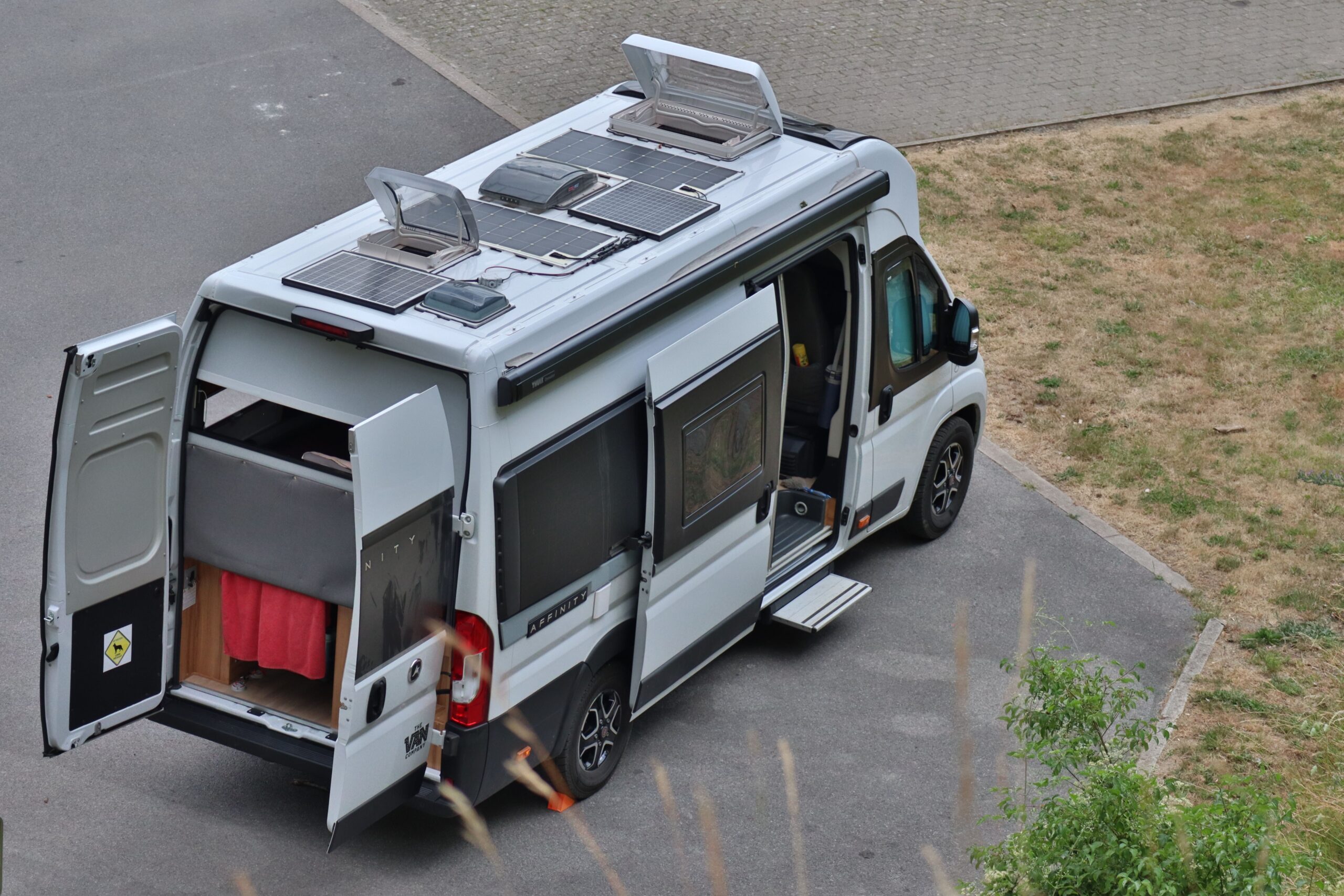
For people considering RV solar for the first time, the first question is often, “How many watts should the panel be?” A commonly used rule of thumb is that a single 100-watt panel produces about 30 amp-hours (Ah) of electricity per day. If you plan to spend several days at a campground without hookups, it helps to begin with that figure.
How Much Power a 100-Watt Panel Produces in a Day
Entry-level RV solar panels generally range from 100 to 400 watts, and first-time system builders commonly start with 200 to 400 watts of total capacity. If your needs are limited to basics such as a refrigerator, lighting, and phone charging, around 200 watts may be enough for several days. But if you regularly use high-draw appliances such as a microwave or coffee maker, it is better to consider 400 watts or more for extra capacity.
Panels, a Controller, and Batteries: The Essential Components
An RV solar system has five main parts: solar panels that generate electricity; a charge controller and safety equipment such as fuses and disconnect switches to prevent overcharging; wiring that carries the power; an inverter that converts DC to AC; and batteries that store electricity. The charge controller is especially essential for battery life because it regulates the raw current coming from the panels before sending it to the batteries. Many systems begin with 12-volt batteries, and it is safer to choose more capacity than your actual calculated need so the system can withstand a day or two of cloudy weather.
You May Not Need It If You Do Not Camp Without Hookups
One common misconception about solar is that it is always worth having. If you only stay at RV parks with electrical hookups, there may be little reason to spend money on solar. On the other hand, for travelers who often visit places without electrical hookups, such as national park campgrounds, solar can be a worthwhile investment despite the upfront cost. It can make for quieter nights without generator noise or fuel expenses. A beginner kit with one panel can be found starting at around $500, making it possible to start without a major initial investment.
Portable or Roof-Mounted: Which Should You Choose?
Roof-mounted panels require little attention once installed and are more likely to receive sunlight regardless of how the RV is parked. Portable folding panels, by contrast, can be placed in a sunny spot after you arrive at the campground, which can make them more useful at sites with heavy tree cover. Lightweight flexible panels ranging from 105 to 180 watts are also available and can be installed on trailers, vans, and even small campers with less sturdy roofs. For a first system, starting with a portable folding panel to understand your usage patterns before moving to a roof-mounted setup can be a sensible approach.
Photo: El Capra, Pexels (https://www.pexels.com/photo/campervan-parked-in-bouillon-wallonia-belgium-38792358/)