
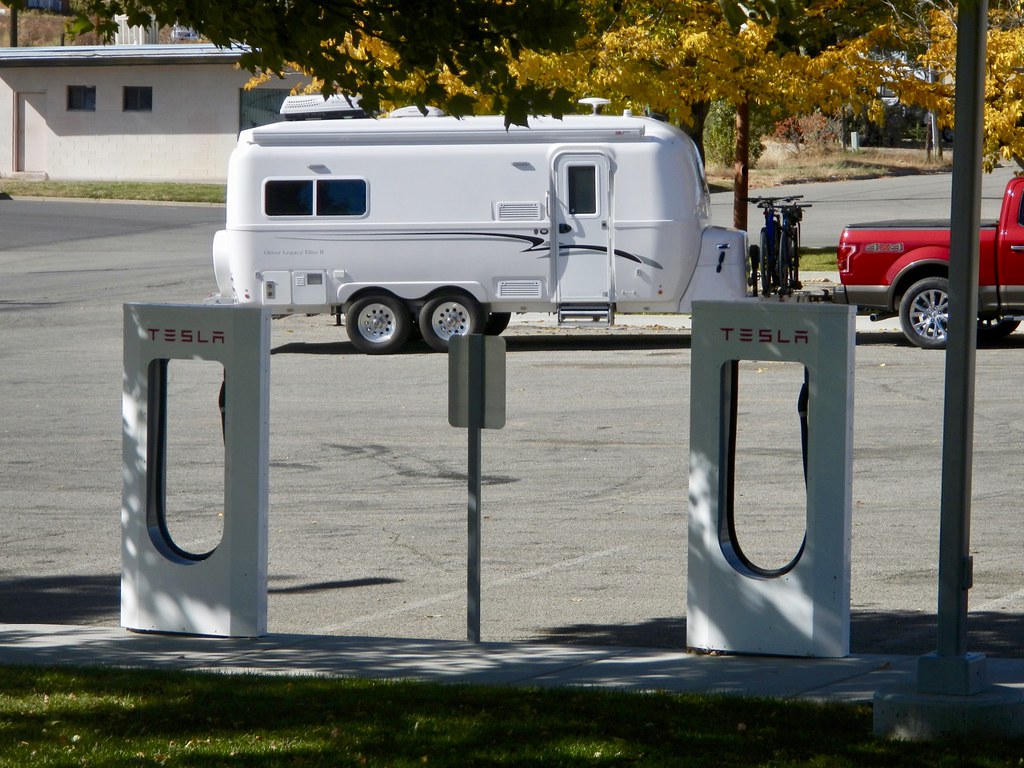
At a factory in Hohenwald, Tennessee, a trailer emerges clad in two layers of fiberglass hull. It is 24 feet long, 7 feet wide, and has a 7,000-pound GVWR. It looks like a small, rounded camper from another era, yet pricing starts at $85,000. This is the Legacy Elite II from Oliver Travel Trailers. Although its price can buy several aluminum trailers of comparable length, the company says its waiting list remains steady year after year.
The Double Hull Drives the Price
The Legacy Elite II is built around a double-hull construction: two molded layers of fiberglass, inside and out. Rather than using a wood frame, wall covering, and staples, the design places a complete fiberglass shell over an aircraft-grade aluminum frame, resulting in far fewer seams and fastener marks. The manufacturer says this construction provides four-season insulation. The base model has a 4,900-pound dry weight, a 7,000-pound GVWR, and an approximately 490-pound tongue weight—within the towing range of a half-ton pickup. Interior height is 6 feet 6 inches, allowing adults to stand upright; exterior height, including the air conditioner, is 9 feet 8 inches, and interior width is 6 feet 7 inches. It carries a 32-gallon fresh-water tank and a 15-gallon wastewater tank, seats seven, and sleeps three.
A Seven-Person Dinette Converts to a King Bed
There are two floor plans. In the standard layout, the rear table is a dinette that seats up to seven and converts at night into a 75-by-79-inch king bed. The side dinette also becomes a 76-by-25-inch bed. The twin-bed layout instead has two fixed rear twin beds, each measuring 75 by 30 inches, with a nightstand and dresser, while the side dinette remains convertible into a 76-by-25-inch bed. Both layouts are available across all trims, giving buyers a choice based on whether they travel as a couple or with children or pets.
91 Standard Features, Plus Four Power Tiers
The manufacturer highlights 91 standard features. From the aircraft-grade aluminum frame to lithium batteries, solar power, tempered-glass double-pane windows, and ducted heat, the company says items often sold as options by other brands are included across the lineup. Power specifications, however, differ clearly by trim. The Standard has a 100 Ah lithium battery and no inverter. The Premium adds a 200 Ah battery, a 2,000-watt inverter, and 400 watts of roof-mounted solar. The Platinum, described as the best seller, has a 320 Ah battery and a 3,000-watt inverter, plus an interior package with a backup camera, keypad door, and microwave-air-fryer combination, along with an outdoor package including a rear hitch, storage basket, and 30-amp connection. The top Platinum Pro uses a 640 Ah battery and 1,360 watts of roof solar, designed for extended use without a generator. A 48V solar awning is optional on the Premium and Platinum and standard only on the Platinum Pro.
Exterior Details That Stand Out
Outside, the trailer has two remote-controlled awnings, one on each side. At the front, a generator storage compartment sits near a 30-amp plug. LED lighting runs along the lower body and sides to improve nighttime visibility, a practical feature when moving around the trailer at a campground after dark. The coupler is rated for 7,000 pounds, matching the GVWR; the air conditioner is rated at 15,000 BTU, and the marine-grade power cord is 25 feet long.
Use, Not Budget, Is the Real Pricing Measure
Even for the same 24-foot trailer, the price gap between the Standard and Platinum Pro comes not from a handful of options but from an entirely different power system. For travelers who bring a generator and stay only at campgrounds with hookups, the Standard may be sufficient. For those who need to remain off-grid for several days, Platinum-level battery and solar capacity is effectively essential. Oliver says the top-trim price approaches $100,000 with individual options such as lithium and solar upgrades and a composting toilet. In contrast, well-kept used units commonly sell in the $55,000 to $78,000 range, making the used market worth considering for buyers looking to reduce the cost substantially compared with a new trailer.
What a Small, Expensive Trailer Is Selling
Ultimately, the Legacy Elite II sells confidence rather than size. Buyers could purchase a much larger trailer for the same money, but Oliver’s double-hull fiberglass construction and limited-production approach target consumers who prefer something smaller and sturdier. For a couple planning to tow long-term and camp through all four seasons, its 24-foot length and 7,000-pound GVWR can be strengths rather than constraints. Prices and specifications in this article are based on materials released by the manufacturer; before purchasing, it is advisable to confirm current trim configurations and prices with a dealer or the factory.
Photo: PunkToad / Original photo. CC BY 2.0. Photo date: October 23, 2017.