
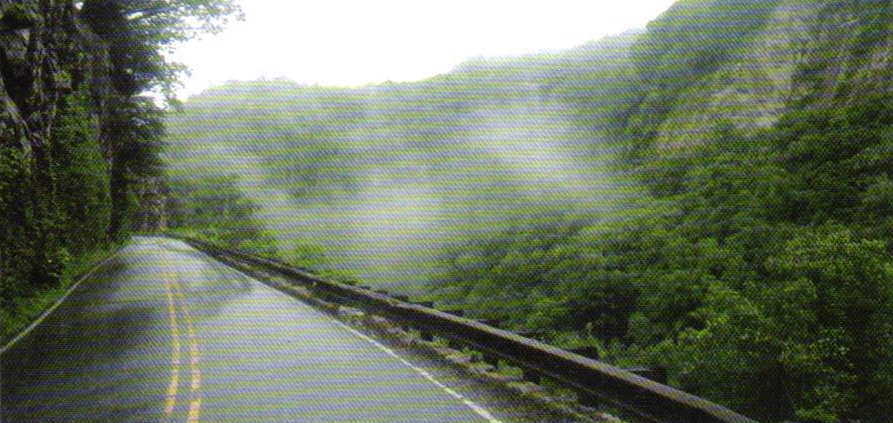
Great Smoky Mountains National Park straddles the border of North Carolina and Tennessee. It is a World Heritage Site and was known as the most visited of the country’s 63 national parks. More than 14 million visits were recorded in 2021. To put its popularity in perspective, the figures I had in mind were roughly 6 million for the Grand Canyon, 5 million for Rocky Mountain and 4 million for Yellowstone.
Google Maps put the drive from Atlanta at 164 miles and just under three hours. In practice, it took us more than four. Apart from our first night on the trip, we hadn’t reserved a campground or a hotel, but I booked two nights in the Smokies while we were still in Atlanta. I had come away from my online search certain that Rose Creek was inside the national park. When we got there, I found a private campground some distance from the park. The facilities were good and the place had a nice feel, but I couldn’t help feeling I’d been fooled. What could we do? We were a long way from home.
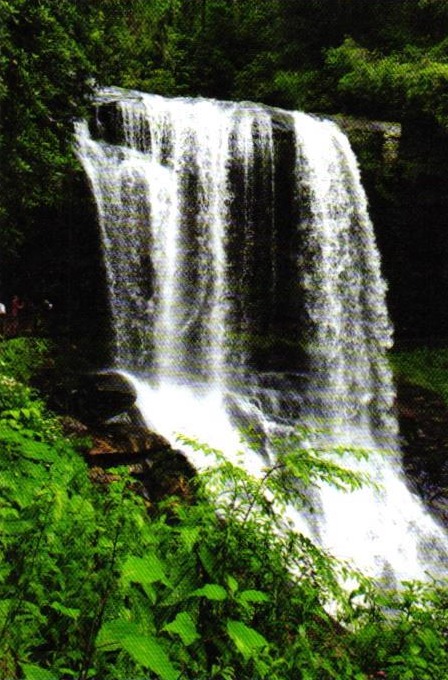
The older man who hosted the campground urged us to visit a nearby waterfall called Dry Falls. With a name like that, I wondered if there would be much of a waterfall at all. The next morning we went to see it and get in a walk. A rushing stream, dense woods and a quiet mountain path made for a lovely setting. The place was evidently well known, judging by the number of visitors. The trail led right behind the falls. Looking out from behind the curtain of water was spectacular.
After our second night at the campground, we set out in the morning to explore the park in earnest. We turned onto U.S. 441, which runs north to south through the park. A huge wooden bust in the gateway town gave it a character all its own. It stood outside what was then called the Museum of the Cherokee Indian, where a log had been carved into a portrait of Sequoyah.
We passed the national park sign and still saw no gate where anyone could collect an entrance fee. We picked up a map at the visitor center, and there was no payment window there either. Just in case, I hung my Senior Pass in the windshield. I learned later that the park charged no entrance fee.
The Smokies have extraordinary scenery that seems to have held on to its ancient character. My notes counted 150 trails, including a rugged stretch of the Appalachian Trail about 71 miles long, and 16 peaks above roughly 5,900 feet. More than 17,000 species of plants and animals had been documented, among them elk, black bears and deer. In Cataloochee Valley, one of the park’s best-known places, a school, barns and homes from the late 19th and early 20th centuries preserve a piece of Southern Appalachian life. They’re favorite subjects for postcards and photographers.
As we drove around, we spotted an inviting campground in the woods. I went to ask whether we could stay a night, but every site had been booked. Disappointed, we carried on southeast along Interstate 40.
Tip
In my notes, I singled out the Great Smokies, the most visited national park, and California’s Redwood National Park for their free entry.
Editor’s note: Both parks offer free entry, and other national parks do as well. The Smokies generally require a separate parking tag for stops longer than 15 minutes. Great Smoky Mountains fees and passes · Redwood fees and passes