
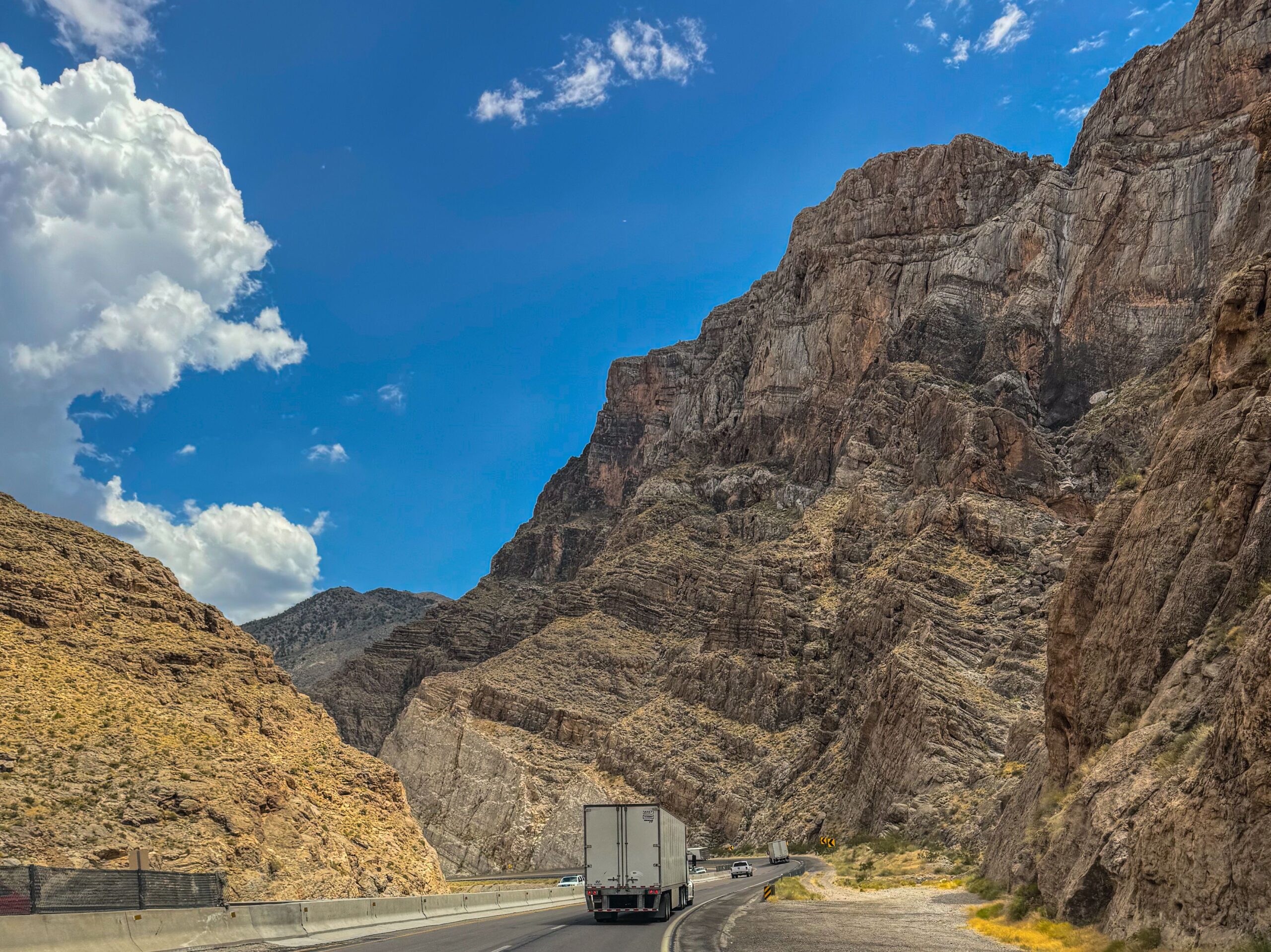
If you press the brake pedal on a downhill grade and the vehicle does not slow as well as it used to, it may already be a late warning sign. As brakes heat up, “fade” can begin, steadily reducing braking power even when you apply the same pressure. If you keep relying only on the brakes, the vehicle can eventually reach a point where it will not stop at all. The risk is greater for heavy RVs that often travel long mountain roads.
Why Hot Brakes Lose Effectiveness
Brakes slow a vehicle by converting its kinetic energy into heat through friction. The problem is how quickly that heat is generated. When a heavy RV must rapidly reduce speed on a steep descent, enormous heat can build up in the brake pads and rotors in a short time. Once that heat exceeds what the components can handle, the pad and rotor surfaces become slippery, and braking force begins to decline even under the same pedal pressure. Continuing to press the brakes hard in that condition can make fade progressively worse and may ultimately lead to a complete loss of braking power.
Select a Lower Gear Before the Descent Begins
The most basic response is to control speed with the engine rather than the brakes. If you want to hold 35 mph on a 6% grade, select the gear appropriate for that speed before heading down. Timing is the key. Trying to shift to a lower gear after the vehicle has already gained speed can be dangerous, or the transmission may not allow the shift at all. Lower the gear before the descent begins, while there is still a margin of safety. Using engine rpm to control speed leaves the brakes in a supporting role and reduces the chance of overheating.
Snub Braking: Apply, Then Release
You cannot avoid using the brakes entirely, but how you use them matters. Riding the brakes—keeping them applied continuously on the way down—is one of the habits to avoid most. Because it constantly creates friction heat, it is the fastest route to overheating. The recommended approach is “snub braking”: apply the brakes firmly and briefly to bring the vehicle down to the target speed, then release them completely. Once speed rises beyond the acceptable range again, brake briefly once more, repeating at intervals of several seconds. This gives the brakes time to cool. Choosing the speed itself also matters. Set the safest speed in advance by considering the weight of the vehicle and cargo, the length and steepness of the grade, road conditions, and the weather.
What Happens When Brake Fluid Boils
The worst-case scenario is boiling brake fluid. If brake fluid inside the caliper boils from overheating, the pedal may briefly produce no response at all—a complete “pedal loss.” In that situation, use the non-hydraulic parking brake to reduce speed and downshift further to regain as much control as possible. If there is a runaway truck ramp, or emergency escape lane, ahead, it is safer to enter it without hesitation. Pedal feel can return as the fluid cools, but knowing the available alternatives before that moment can help prevent panic.
Read Warning-Sign Numbers as Gear Choices
Signs at the start of mountain roads commonly show the grade. They often list both slope and distance, such as “6% grade, 3 miles.” Rather than passing those numbers by, use them as a prompt to choose your target speed and gear right then. The steeper and longer the descent, and the heavier the vehicle and load, the lower the gear and target speed need to be. Continuing downhill in a high gear after seeing the sign, then trying to control speed with brakes alone too late, is one of the most common paths to brake fade.
When Towing a Trailer, Check the Brake Controller Too
When towing a travel trailer or fifth wheel, the tow vehicle’s brakes alone are not enough. If the trailer brake controller is set too weakly, the trailer’s weight transfers directly to the tow vehicle’s brakes on a descent, accelerating overheating. Check the controller’s response on level ground before departing, and verify its brake-force setting again before entering mountain roads. The trailer and tow vehicle brakes must operate together and promptly for lower gears and snub braking to work as intended.
Do Not Simply Pass By Brake Check Areas
In mountainous regions, it is common to see brake-check signs with messages such as, “Trucks stop here, check brakes, steep grade ahead.” These signs are not only for commercial trucks; they apply to all vehicles exceeding the stated gross-weight threshold, including pickup trucks towing RVs. When you reach the pullout indicated by the sign, do not simply pass it by—stop and check the brakes. If you have an infrared thermometer, checking brake-drum temperature is also an option. Above 500°F is a sign that the brakes need time to cool, while above 600°F means you should stop immediately and treat the brakes as having reached their limit. Even without a thermometer, a burning smell from the brakes or a softer-than-usual pedal should be taken as the same warning. Let the brakes cool sufficiently before continuing. Remember that stopping for a few minutes is far less burdensome than dealing with an accident for hours.
Check the Brakes Before Reaching the Summit
The best strategy is to prepare before a problem develops. Before reaching a long descent, make a habit of reducing speed enough and selecting a lower gear in advance. It is far better to check brake condition at the summit before climbing over it than to respond after the brakes have already overheated. An uphill naturally reducing your speed is entirely different from realizing too late, midway down a descent, that your brakes are gone. When you see a turnout or shoulder where it is safe to stop, briefly pull over and check for brake odor or changes in pedal feel. That habit can help prevent a major crash.
Ultimately, Preparation Is the Answer
Brake fade on mountain descents does not arrive without warning. A pedal that feels softer than usual, or slower deceleration despite applying the same pressure, is the warning sign. Recognizing that sign and immediately reducing speed and shifting to a lower gear can make the difference between a crash and a safe trip. If you drive a heavy RV through mountain roads, it is safer to make a habit of choosing your gear and speed before entering a descent. Tire pressure and tread wear should also be checked before a long downhill grade, not just the brakes. Even strong braking is of little use if the tires cannot properly grip the road. Briefly stopping to let the brakes rest whenever you reach a turnout or shoulder can substantially reduce the likelihood of fade.
Photo: Igor Passchier — Pexels (https://www.pexels.com/photo/a-truck-driving-down-a-highway-in-the-desert-27681583/)