
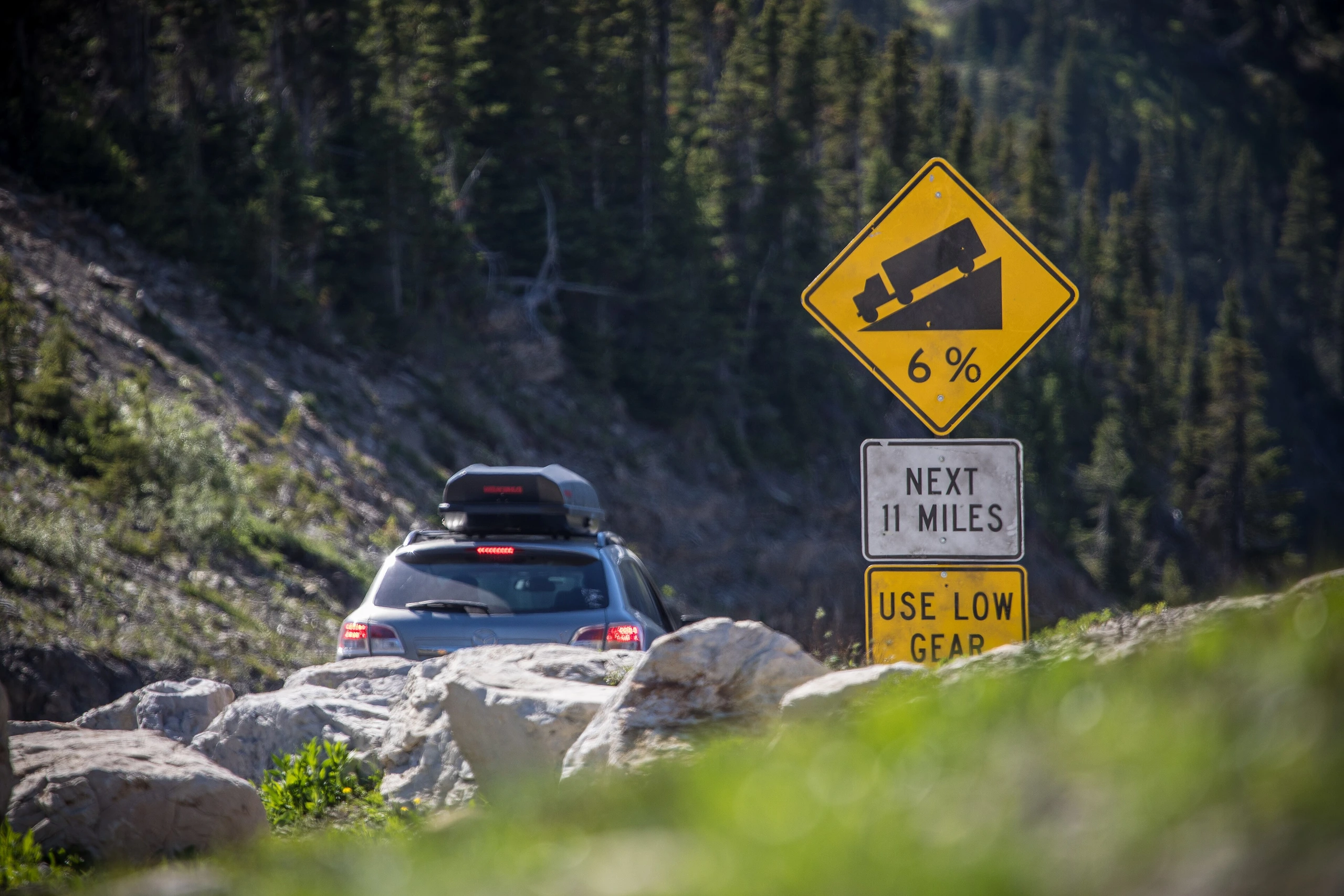
In northwestern Montana, Glacier National Park stretches along the spine of the Rockies, known for its shrinking glaciers, alpine meadows, steep valleys, and lakes. Along with more than 700 miles of trails, the park’s defining feature is Going-to-the-Sun Road. Crossing the park east to west over Logan Pass, the route draws RV travelers each summer—but it is also a turning point for larger vehicles.
21 Feet, 8 Feet, and 10 Feet
For the summer 2026 season, Going-to-the-Sun Road was fully open over Logan Pass from both the West Glacier and St. Mary entrances. Strict vehicle-size limits remained in place, however, between Avalanche Creek and Rising Sun. Vehicles or vehicle combinations exceeding 21 feet in length, including bumpers, or 8 feet in width, including side mirrors, could not travel through this section. In addition, vehicles taller than 10 feet could encounter trouble from projecting rock along the descent from Logan Pass toward The Loop.
Travelers towing a fifth wheel or a large travel trailer will often need to skip this stretch altogether. Larger vehicles can still access the road from either end, making it practical to explore the West Glacier and St. Mary sides separately, then use the park-operated Logan Pass Shuttle for the central Logan Pass section.
Campgrounds Without Electric Hookups
According to Recreation.gov RIDB data for major campgrounds in and around the park, Glacier National Park campgrounds generally operate as standard non-electric sites, without electric or water hookups.
On the west side, Fish Creek Campground has relatively short maximum vehicle lengths of 19 to 21 feet, depending on the site, making it better suited to small or midsize trailers and van travelers than large RVs. On the east side, St. Mary Campground accommodates vehicles from 22 to 35 feet, depending on the site, giving comparatively larger RVs more options. Many Glacier Campground also varies by site, from 20 to 30 feet, so travelers should confirm the maximum vehicle length for an individual site before reserving. Driveway lengths also vary at all three campgrounds, making it important to check both driveway length and maximum vehicle length on the reservation page.
Reservations at most of these campgrounds open six months in advance, while some sites have shorter booking windows that open four days ahead. During the popular July and August season, sites often fill as soon as reservations open, so it is best to plan early.
Bowman Lake and Kintla Lake campgrounds, deep on the park’s west side, require a lengthy drive on unpaved roads. They are better suited to small vans or tent camping than to large RVs. At the far eastern end of the park, Two Medicine Campground also has a narrow access road that can make entry difficult for larger vehicles, so travelers should review the campground’s access-road guidance before booking.
What RV Travelers Need to Know
According to National Park Service (NPS) alerts, smoke from recent regional wildfires was affecting air quality in the park. Visitors should check air-quality information before visiting and adjust outdoor activity for their own sensitivities and those of their companions. In addition, construction at Two Medicine Campground during the 2026 season made the Two Medicine North Shore Trailhead inaccessible, with a detour requiring hikers to cross a creek on foot. To reach Twin Falls, Upper Two Medicine Lake, No Name Lake, and Dawson Pass without crossing the creek, visitors needed to use the South Shore Trail, adding about 1 mile each way.
Entrance fees were $35 per vehicle for seven days, or $25 during the winter period from November through April. Those entering on foot or by bicycle paid $20 per person. Motorcycle entry was $30 for seven days and covered up to two motorcycles and four people. Even when entrance stations were unstaffed, visitors still needed to pay at self-service payment areas.
Tips for Enjoying Going-to-the-Sun Road by RV
For travelers with larger rigs, the simplest approach is to leave the motorhome at the campground and tour Going-to-the-Sun Road in a separate small tow vehicle, or toad. The Logan Pass Shuttle can help avoid peak-season congestion, but its operating hours and seating are limited, so travelers should review the schedule ahead of time. With the Rockies’ characteristically changeable weather, a waterproof jacket and extra clothing are wise even in midsummer. Warm, humid air from the Pacific and cold, dry air moving down from the northeast meet along the Continental Divide, allowing conditions to shift quickly within a single day.
In some peak summer seasons, access to Going-to-the-Sun Road itself has been managed through an advance vehicle-reservation system. Before visiting, travelers should check Recreation.gov to see whether vehicle-reservation requirements apply for that season. During periods when requirements are in effect, access to certain sections may be restricted without an advance reservation, potentially disrupting an entire RV itinerary.
A More Relaxed Way to Explore
More travelers are planning to spend several days on the West Glacier side and several more on the St. Mary side, rather than packing up and moving their campsite between the two. Rather than trying to force a large RV through the central section while traveling between the road’s two ends, enjoying the west and east sides from separate campgrounds is a more practical way to see the park without being constrained by vehicle-size limits. Travelers can explore western trails and lakes near Fish Creek or Apgar, then take in the eastern alpine scenery from St. Mary or Many Glacier. With that kind of itinerary, even a brief Logan Pass trip by shuttle or small vehicle can make for a rewarding visit.
Data Source: NPS API (developer.nps.gov) / Recreation.gov RIDB
Photo: GlacierNPS / Original photo. Public domain. Photo date: 18 July 2018, 19:09:38. Resized and compressed for display.
