
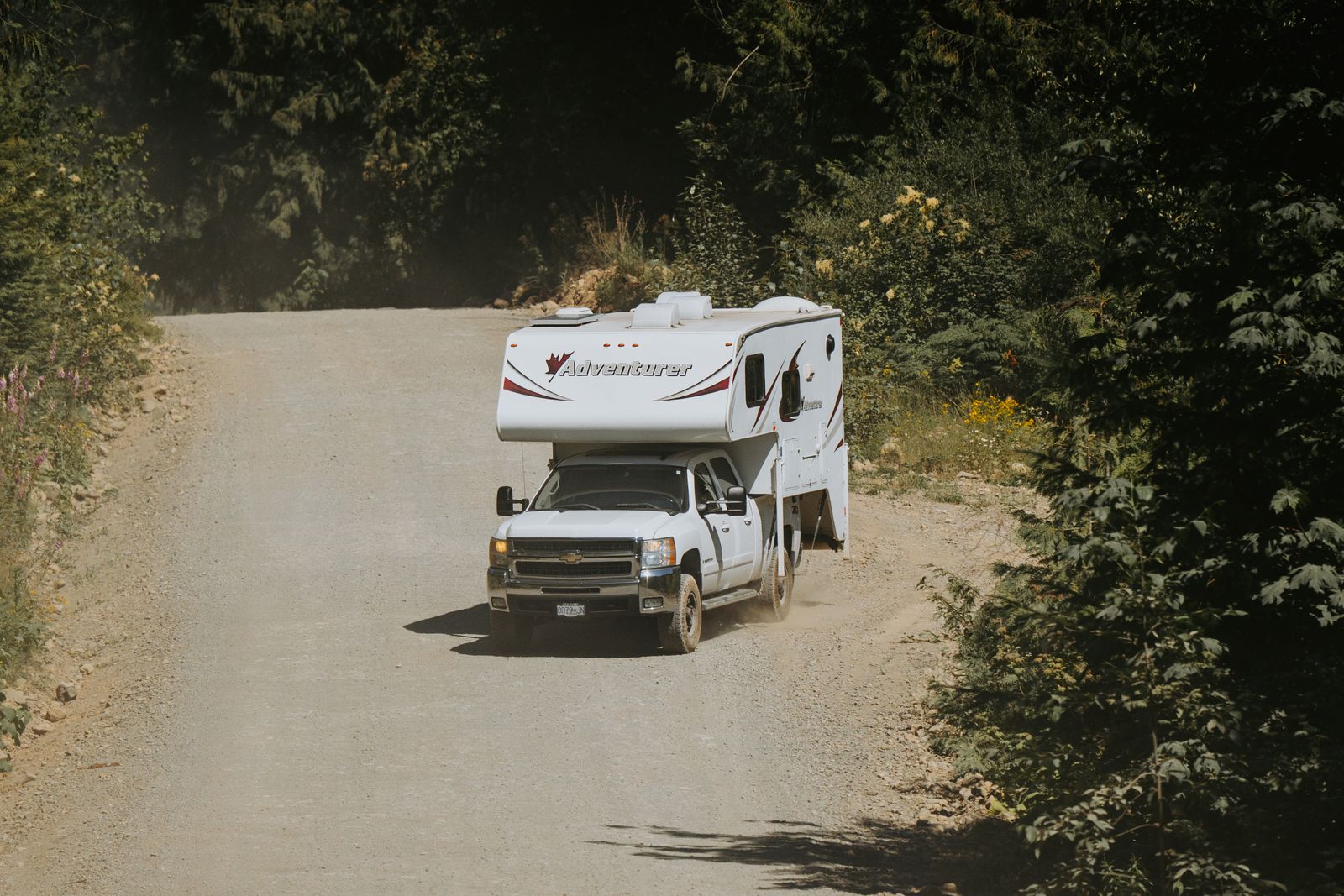
It is neither a travel trailer nor a fifth wheel. A truck camper rides directly in the bed of a pickup. This setup requires no separate tow vehicle, and once the camper is removed, the truck immediately returns to being a four-wheel-drive off-road vehicle. But because a single truck has limits on the weight it can carry, the selection process differs somewhat from that of other RVs.
A Home Carried in a Truck Bed
Truck campers generally fall into two categories: hard-side and pop-up. Hard-side models have permanently solid walls, providing better four-season insulation and more interior room, but they also weigh more. Pop-up models can lower their roof while driving, reducing height and weight and placing less of a burden on fuel economy, though the roof must be raised each time camp is set up. Lance Campers’ 2026 lineup alone includes 11 models: the non-slide 650, 825, 850, 865, 960, and 1191; the single-slide 855S and 975; and the double-slide 1062 and 1172. Among them, the non-slide 1191 is priced at $55,949, the 865 at $37,567, the double-slide 1062 at $57,185, and the 1172 at $62,284.
In Northstar Campers’ hard-side range, the Wind Bandit sells for $37,250, the Nighthawk for $41,760, and the 10X for $51,520. Its pop-up line is considerably less expensive: the 600SS is listed at $27,175, the GMAX600 at $28,475, the GMAX650 at $29,775, and the 850SC at $31,175. Even within the same brand, the difference between pop-up and hard-side models can exceed $10,000.
Start With the Weight Your Truck Can Carry
The first consideration when choosing a truck camper is not the camper’s size but the truck’s payload capacity. The combined weight of the camper, people, water, and gear must not exceed the payload rating specified by the truck manufacturer. A non-slide hard-side model can sometimes be carried by a half-ton pickup, but heavier models such as double-slides require a three-quarter-ton truck in the 250 or 2500 class, or a one-ton truck in the 350 or 3500 class. Bed length also matters. Putting a camper designed for an 8-foot bed on a truck with a 6.5-foot bed leaves the rear overhanging and disrupts weight distribution.
What You Gain—and Give Up—Without Towing
With a travel trailer or fifth wheel, campers can leave the trailer at the campground and use the truck for errands. A truck camper does not offer that option unless the camper is unloaded; otherwise, it travels with the camper aboard. In exchange, there is no need to practice backing a trailer or worry about trailer parking space, and the truck retains its inherent maneuverability on unpaved forest roads and narrow mountain routes. That is also why truck campers remain a steady choice among people who enjoy boondocking. Many models are designed to support several days away from electrical hookups and running water with only a generator or solar panels.
The interior is noticeably tighter than that of a travel trailer. Many use a cab-over layout, placing the bed above the truck cab, and some require a ladder for access. They tend to suit one or two travelers rather than families, especially those who need to carry equipment in the truck for pursuits such as hunting or fishing.
Who Is This the Right Choice For?
For someone who already owns a three-quarter-ton or larger pickup and prioritizes rough-road access with minimal towing demands, a truck camper can be a sensible option. But for buyers who must also purchase a truck, the total cost can sometimes approach that of a typical Class C motorhome, making a careful budget review essential. A pop-up lowers the initial cost but requires raising and lowering the roof on every trip, while a hard-side removes that task but demands more weight capacity and a higher price. Ultimately, the truck a buyer already owns is the first consideration in selecting a truck camper.
What Changes With Slide-Outs
Single-slide models such as the Lance 855S and 975 add standing room and features such as a fixed sofa, but the added space also adds weight. Moving up to double-slide models in the 1062 or 1172 class brings a layout closer to a living-room arrangement, though truck choices narrow to three-quarter-ton models and above. Because slide-outs stay retracted while driving and extend only after parking, travelers should also consider that a narrow forest road or a snow-covered dispersed site may not leave enough room to deploy them.
What to Check on the Used Market
Many buyers enter the truck-camper market through used units rather than new ones. Beyond the camper’s own condition, it is important to find out what truck the previous owner used and whether the combination had sufficient payload margin. Check for water stains on the floor or walls, confirm that all four jacks work properly, and inspect whether the tie-down system attaches correctly to the truck frame. Buyers adding a new camper to an existing truck should always compare it with the manufacturer’s truck-specific compatibility chart. They should also ask whether the seller’s stated weight is the camper’s dry weight alone or its ready-to-travel weight with water tanks and batteries filled, so the payload calculation is not thrown off later.
Insurance and Registration: How They Differ From Trailer RVs
Because a truck camper sits on rather than permanently attaches to the truck, owners often need RV insurance for the camper in addition to truck insurance. Most states do not require a separate license plate as they do for trailer RVs, but some may classify a camper with cooking facilities and a bed as an RV, which can change tax or registration procedures. Before buying, it is wise to confirm local rules with an insurer or registration agency. If the truck and camper were purchased at different times, keep both sets of documents together so they can be compared during a sale or insurance claim.
Loading and Unloading Takes Practice, Too
The ability to fully remove a truck camper is an advantage, but it also means becoming comfortable with the loading and unloading process. The camper is lifted with four jacks, then the truck is driven out from beneath it. On ground that is not level and firm, the jacks can tilt. First-time owners are safer practicing several times on level ground before trying it in the field. Being able to leave the camper behind and drive only the truck for errands is a practical advantage unique to truck campers over travel trailers. For the first few times, it is safest to work with a companion and exchange signals; with experience, one person can usually complete loading or unloading in about 20 minutes.
Photo: Luke Miller, Pexels — https://www.pexels.com/photo/a-truck-driving-down-a-dirt-road-with-an-rv-on-it-27489810/