
New travel standards took effect June 7 on Zion-Mount Carmel Highway, which crosses Zion Canyon. Vehicles using the stretch between Canyon Junction and the East Entrance must now meet all four limits for length, width, height, and weight. Vehicles exceeding the limits must turn around at the South or East Entrance. The rules apply to the entire corridor from Canyon Junction to the East Entrance—not just the Zion-Mount Carmel Tunnel—so bypassing the tunnel does not avoid the restriction.
What Size Vehicles Are Restricted?
For a single vehicle, access is prohibited if it exceeds 35 feet 9 inches in length, 7 feet 10 inches in width, 11 feet 4 inches in height, or 50,000 pounds. Combination vehicles—a truck towing a trailer—face slightly different limits: 50 feet in overall length; 26 feet from the hitch to the trailer’s rearmost axle; 7 feet 10 inches wide; 11 feet 4 inches high; and 50,000 pounds. Side mirrors, tires, rooftop air conditioners, bike racks, and satellite antennas all count toward the measurements. In other words, a measurement taken with a tape measure at home may differ from the dimensions that matter on the road. Drivers towing a fifth wheel or large travel trailer should pay particular attention to the 26-foot limit from the hitch to the trailer’s rearmost axle. A rig may comply with the overall-length limit but still be restricted based on the trailer section alone.
Why This Road?
The standards were not created from scratch. They were established based on safety studies conducted in 1989 and 2019 and validated by the Federal Highway Administration. The findings concluded that vehicles over the length limit cannot reliably stay in their lane through the road’s tight curves and switchbacks, while vehicles exceeding the width or height limits cannot pass through the Zion-Mount Carmel Tunnel in a single lane. Vehicles over 50,000 pounds exceed the capacity of four bridges along the route. Completed in 1930, the road is a historic structure listed on the National Register of Historic Places and recognized as a Historic Civil Engineering Landmark; it was never designed for today’s large vehicles. Large vehicles were also a concern under the tunnel’s existing escort system. A 2016 study found that free-flowing traffic averaged only 19 minutes per hour, falling to 8 minutes on the busiest days.
Camping Access Is Still Possible
There are exceptions for vehicles that exceed the limits. They include cases where space is available in the oversized-vehicle parking area next to the Zion Canyon Visitor Center; guests with reservations at Zion Lodge; drivers using Zion Canyon Scenic Drive during periods when the shuttle is not operating; and campers headed to Watchman Campground or South Campground. All 124 sites at South Campground are tent or RV sites without electric hookups, and the nightly rate is $35. Reservations open up to two weeks in advance, and no walk-in sites are available. At Watchman Campground, 92 of its 184 sites have electric hookups, with reservations available up to six months ahead. Non-electric sites cost $35, while electric sites cost $45. Generators are not allowed, even at electric sites. Stage 2 fire restrictions were also recently in effect, fully prohibiting campfires and charcoal use at Watchman and South Campgrounds. Campers should bring reservation confirmation to help avoid delays at the entrance.
Detour Options
Travelers headed toward Bryce Canyon can detour via U.S. Route 20 north of Cedar City. It adds 63 miles compared with Zion-Mount Carmel Highway, but only about 42 minutes of driving time. The detour follows a gradual interstate route that is less demanding for large RVs. For drivers simply hoping to pass through Zion, adding the detour to the itinerary in advance is preferable to paying the park entrance fee only to be turned around at the gate. Park officials have also made clear that they are not considering widening the road to accommodate larger vehicles. The tunnel, bridges, and switchbacks completed in 1930 are themselves historic structures listed on the National Register of Historic Places, and road expansion would undermine their preservation value. The restriction should therefore be viewed not as a temporary measure but as a rule likely to remain in place.
What to Check Before Departure
Zion’s official oversized-vehicle information page details how over-limit vehicles are handled at the South and East Entrances, along with the circumstances that qualify for an exception. It is also wise to check the park’s alerts page. At the time, a cyanobacteria toxicity alert was also posted for the Virgin River and park waterways, advising visitors not to submerge their heads in the water or use it as drinking water without filtration. Hikers planning Angels Landing should also remember that a separate permit is required, apart from any campground reservation. The oversized-vehicle parking area by the Zion Canyon Visitor Center has limited spaces and may fill on a first-come, first-served basis.
Anyone planning an RV trip to Zion should take out the tape measure before leaving home. It is safest to confirm the rig’s actual length, width, and height—including side mirrors and roof-mounted equipment—before arriving at the South Entrance. Measuring and planning at home is far easier than arriving slightly over the limit and having to rework the route on the spot. Even when a campground reservation allows passage, having the confirmation printed or ready on a phone can speed the entrance verification process.
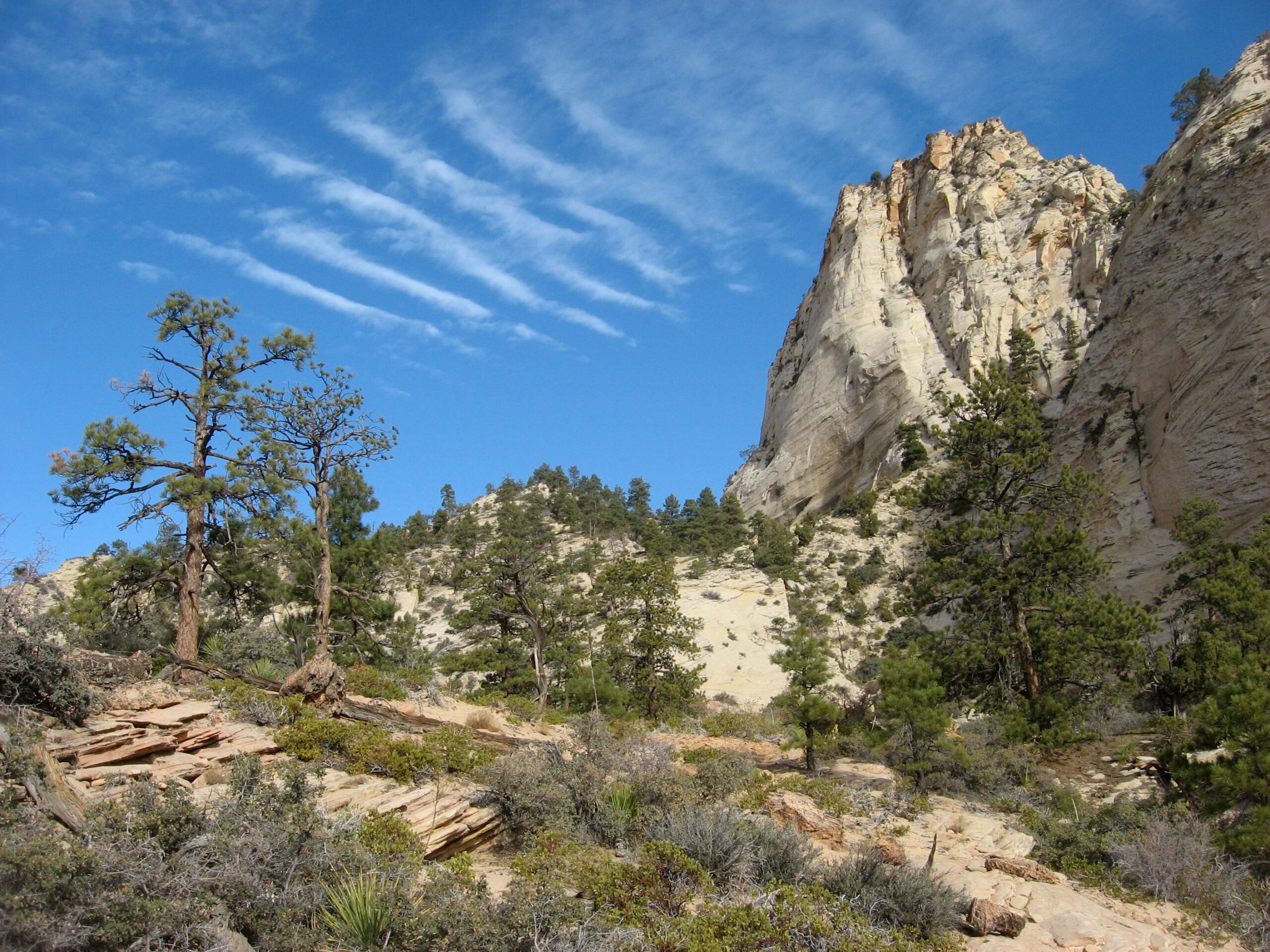
Photo: NPS Photo / Caitlin Ceci, https://www.nps.gov/zion/index.htm