
Keeping faith with our resolve to visit every park or monument with “National” in its name, we leave Arizona for White Sands National Park in New Mexico. Again we follow I-10, turning onto Highway 70 at Las Cruces before El Paso. The driving is not difficult, but the featureless desert makes a little over 100 miles feel very long. With no internet, the navigation stops working, too.
Daylight fades, but the campground marked on the map never appears. We see what looks like a settlement and a few RVs. “This must be it,” we think, driving in—only to be stopped by a sentry. It is a military base. Beside the road is a Missile Range Museum sign. Air bases and missile testing grounds surround the park. When I explain that we are looking for camping, we are told to continue. The nearest city, Alamogordo, is 15 miles northeast. It has no campground but does have RV parks, hotels, motels, markets and gas stations. It is late, and the RV park’s owner has left. We write down our license plate and departure date, put the note and payment in the box, and settle into an empty space.
We leave early for White Sands the next morning. On the approach, a Border Patrol checkpoint screens visitors. I have heard that a driver’s license or passport may be needed, but when I say I am a citizen, we are waved through without further questions. From the visitor center, the park road loops around at its far end and returns the way it came, so there is little risk of losing the route.
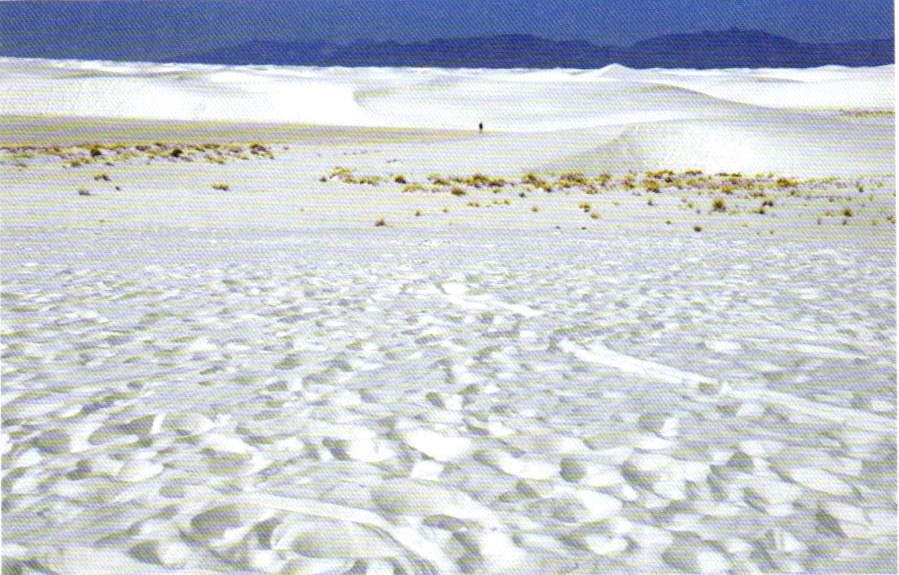
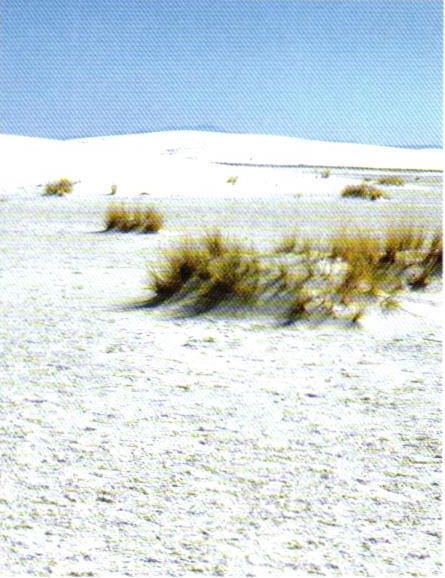
White Sands was elevated from a national monument to a national park in 2019. Its brilliant white dunes, reshaped moment by moment by the wind, are extraordinary. White sand stretches like endless waves over 275 square miles, the world’s largest gypsum dunefield. Strong southwesterly winds, I hear, keep these rippling dunes changing and moving.
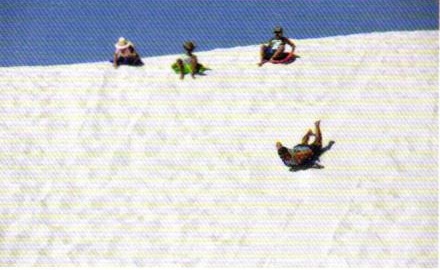
Parking areas have restrooms and picnic tables for a break, but no drinking water, so bring your own. Near the parking, children delight in sledding down the dunes; sleds can be rented for a fee at the visitor center. Hiking is possible, too, but with everything white, it is hard to distinguish a trail from the surrounding sand. Keep track of your position, carry plenty of water, wear a hat and sunscreen, and return before sunset.
Half a day is enough to look around, excluding travel time. Famous as this New Mexico national park is, its atmosphere differs from what we associate with California’s national parks. Instead of the two nights we planned, one day proves sufficient.
CAMPING
There is no lodging in White Sands. There is only a small, ten-site campground for backpackers, without shade or drinking water. It does not take reservations; sites are assigned first come, first served at the visitor center until one hour before sunset.